Jordan Smith stuns the stars to claim one point Slam glory
A 29-year-old amateur coach from Sydney turned a sudden-death format into a national sensation, toppling world-class talent and claiming a A$1 million prize that has left the professional tour in disbelief.
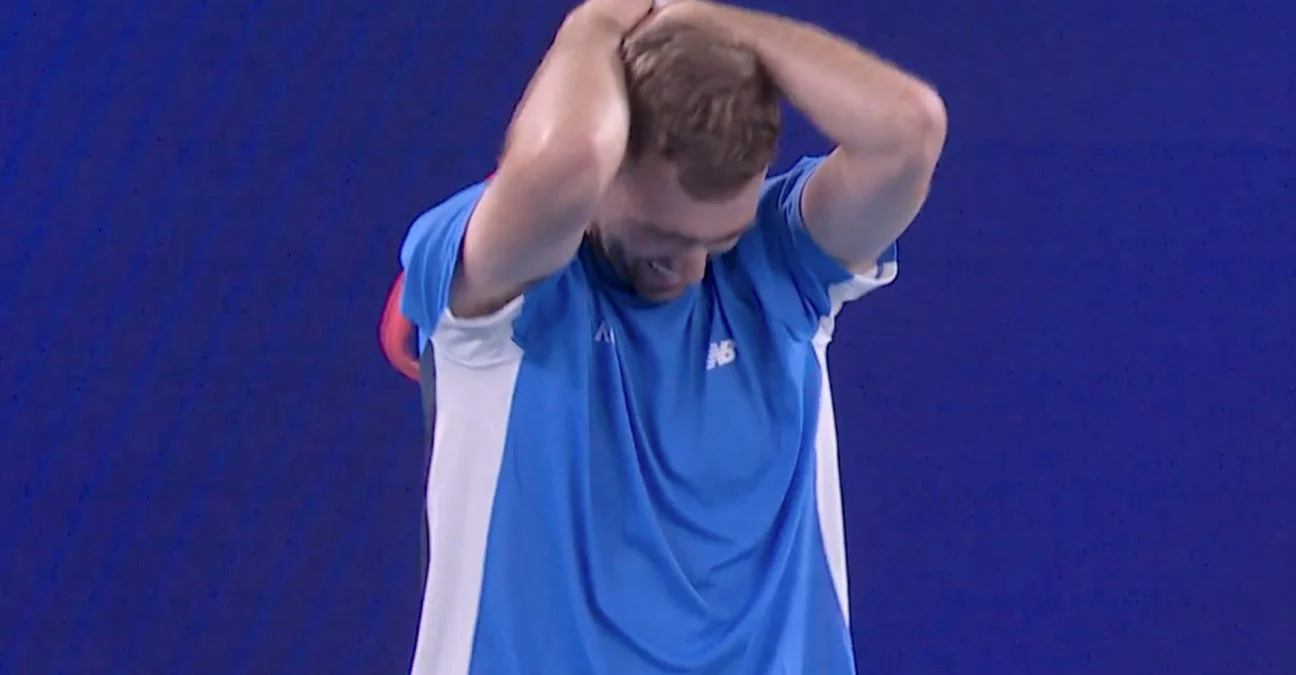 Jordan Smith, 2026 Australian Open | © Tennis Australia

The Australian Open transcended its own traditions on Wednesday at the Rod Laver Arena. In a script that felt more like a social media fever dream than a professional tournament, Jordan Smith, a 29-year-old amateur coach from Sydney’s Hills District, walked away from center court as a millionaire.
The second edition of the One Point Slam, an exhibition format that prioritizes nerves of steel over endurance, concluded with the most improbable result in recent tennis history. Smith, the New South Wales state champion who spends 50 hours a week teaching serves at his family’s academy, defeated a field of 24 top-tier professionals and celebrities to claim the A$1 million prize.
The Anatomy of an Upset
The One Point Slam is a brutal, sudden-death knockout where the margin for error is non-existent. Each “match” consists of a single point. To level the playing field, the tournament employs two radical equalizers: a game of rock-paper-scissors to determine who serves, and a handicap where professional players are restricted to a single serve, while amateurs receive two.
Smith’s path to the trophy was a masterclass in composed opportunism. His first scalp was AFL star Bailey Smith, followed by world No. 86 Laura Pigossi. However, the atmosphere shifted when he drew the tournament favorite and world No. 2, Jannik Sinner.
In a moment that stunned the 15,000-strong crowd, the pressure of the “one-serve” rule proved too much even for the reigning Melbourne king. Sinner’s delivery clipped the tape and fell wide, handing Smith a victory without the amateur even swinging his racquet. Smith followed the upset by ousting US Open finalist Amanda Anisimova in the quarter-finals and Spaniard Pedro Martínez in the semi-final.
In the final, Smith faced world No. 117 Joanna Garland, who had become a giant-killer in her own right by dispatching Alexander Zverev, Nick Kyrgios, and Maria Sakkari. After a short exchange of baseline blows, Garland’s backhand sailed wide. Smith collapsed to the court – a million-dollar winner after playing exactly six points of tennis.
“Just Pray”: The Locker Room Reacts
The professional tour’s response has been an unusual mix of disbelief and genuine celebration. Carlos Alcaraz, who exited the tournament after a failed drop-shot against Maria Sakkari, was seen on the big screen erupting with joy in the locker room when Smith secured the winning point. He later posted a simple, resonant tribute on X: “Jordan Smith.”
Coco Gauff was equally effusive, highlighting the event’s appeal to the “underdog” narrative that modern social media thrives on:
“Great event! lol I said when it started I hoped an amateur won!! Congrats Jordan. sooo cold.”
Even those who weren’t in Melbourne felt the FOMO. World No. 5 Taylor Fritz took to social media to admit, “Now that I’m actually watching it on TV, massive L from me to not be playing the one point slam, this looks like so much fun.”
The “TikTok-ification” of the Court
Despite the commercial success – the event was a sell-out and trended globally for six hours – the One Point Slam has sparked debate. Purists have criticized the “TikTok-ification” of the sport, citing the heavy reliance on commercial breaks and the gimmicky rock-paper-scissors starts.
However, for Tennis Australia CEO Craig Tiley, the afternoon was an unmitigated victory for the tournament’s brand. “This is the ultimate grassroots-to-Grand Slam experience,” Tiley said. “Fast, unfiltered, and open to everyone.”
For Smith, the “Smiling Assassin” of Sydney, the reality is more practical. When asked about his winnings, his mind was on Australia’s notorious property market. “In Sydney, this might buy me half a house,” he joked, clutching the trophy. “Or a really nice apartment.”
As the main draw of the 2026 Australian Open begins this Sunday, the world’s elite will return to the grueling best-of-five format. But for one afternoon in January, the distance between an amateur coach and the world’s best was exactly one point—and Jordan Smith was the only one who didn’t blink.