« Never seen Daniil playing like this » : Why Alcaraz happened to finally lose a tennis match in 2026
Carlos Alcaraz lost for the first time in 2026 on Saturday, and he was the first to say why – Daniil Medvedev played a match the world No. 1 had never seen from him before. Three reasons explain the defeat, and none of them have much to do with excuses.
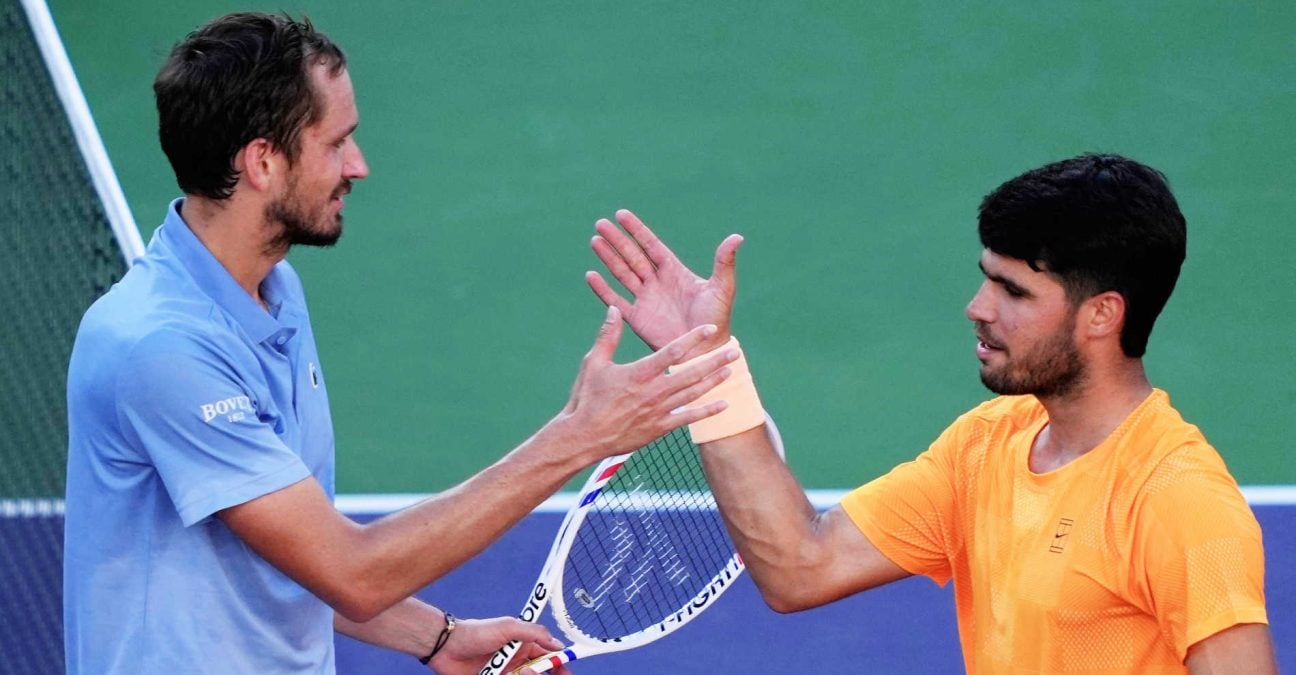 Daniil Medvedev and Carlos Alcaraz, Indian Wells 2026 | © Mark J. Terrill/AP/SIPA

Carlos Alcaraz walked off Stadium 1 on Saturday afternoon having lost a tennis match for the first time since November 2025, at the ATP Finals. He was thoughtful, and largely unbothered when the moment came to find an answer to what had seemed unthinkable even days ago: how was it possible?
What stayed with him was simpler than that: he had just watched Daniil Medvedev play the best tennis he had ever seen from the Russian, and there was not much he could have done about it.
The 6-3, 7-6(3) defeat was Alcaraz’s first of 2026, ending a 16-match winning run that had included the Australian Open and the Doha title. It sets up a Medvedev-Sinner final on Sunday. Here, broken down, is why it happened — with the help of Carlitos.
1. Medvedev “playing unreal”
There are losses you can explain away and losses that simply demand acknowledgment. This was the second kind. Alcaraz did not hedge or qualify – he said it plainly and repeatedly.
“I have never seen Daniil playing like this before,” the Spaniard said in his post-match press conference. “He was playing unreal, I gotta say. He deserves completely the win today.”
What made Medvedev so difficult to handle was not just the level, but the combination of aggression and accuracy that rarely arrive in the same package. Pressure was supposed to produce errors from the Russian. It never did. If anything, the opposite happened – the harder Alcaraz pushed, the cleaner Medvedev responded.
“How aggressive he played all the time – that surprised me,” Alcaraz said. “I knew at the beginning that he was going to play aggressive, but the way he did it surprised me a lot, because he didn’t miss any, or he didn’t miss as much as I expected. He was playing aggressive, and he didn’t even miss.”
The statistics confirm what Alcaraz felt. The numbers beneath the surface tell their own story. Medvedev spent 30% of points in attack – seven percentage points more than Alcaraz, a complete inversion of how both men had played for the rest of the tournament. When Alcaraz did manage to seize control of a rally, his conversion rate dropped 10 points below his tournament average, finishing at 67%. Even when he was forced onto the back foot, the steal rate – winning points from a defensive position — fell 8 points short of his norm, settling at 33%. In other words, Alcaraz was less aggressive than usual, less clinical when he did attack, and less resilient when he was under pressure.
The plan was just to play the way I did with the whole previous matches, hit the ball great, put him in pressure, serve great
On another note, Medvedev committed zero double faults across the entire match – not a single free point surrendered – and won 74.2% of points on his second serve, turning what is normally the most attackable ball in tennis into a weapon. The Russian had removed the one consistent lever Alcaraz uses to build return pressure, and he did it for an hour and 37 minutes without blinking.
“I’m in confidence and when I’m in confidence, I always said I feel like I’m an aggressive player, especially on my serve, it’s a bit different on the return”, Medvedev said. “But even on the return, whenever I get the opportunity, I tried to dictate the point afterwards. So today there was no plan to be, like, too aggressive, because that can cost you against Carlos, who is great on defense, so you can start making too many errors. The plan was just to play the way I did with the whole previous matches, hit the ball great, put him in pressure, serve great, and it worked out well.”
Q. Well done today. You said after your quarterfinal win that you’re okay to play the villain or the antihero. Do you feel like you did that at all today?
DANIIL MEDVEDEV: No, today, I mean, in a way where we speak about Carlos, No. 1 in the world, his winning streak, et cetera, maybe. But I think I was completely normal today. I mean, just playing my game. He was actually trying more to get the crowd and stuff like this, because, well, he needed it (smiling).
2. The heat exposed Alcaraz’s margins – and Medvedev exploited every one of them
Alcaraz was careful not to use the conditions as a reason, and he was right to be careful. But he was also honest about what playing a day session at Indian Wells – in full afternoon heat touching 33 degrees, against a man who generates some of the longest rallies on tour – actually costs physically.
“The long rallies, especially when you play against Daniil, you have to increase all the power in almost every shot,” he said. “It feels like you’re wasting extra energy after every shot. And with the heat, sometimes it’s really tricky to deal with all of that.”
Every rally that Medvedev extended – and the Russian extended most of them deliberately, using his deep court positioning to absorb pace and redirect – was a rally that cost Alcaraz slightly more than it cost his opponent. By the time the second set arrived, Alcaraz said he felt better, and the scoreline reflected that. But the first set had already been decided, and the tactical adjustments he made came too late to change the fundamental dynamic.
Those adjustments – variation shots, more height on the ball, higher bounce, waiting longer before going aggressive – were the right ones. Alcaraz got to the net more often, created chances, and pushed the match to a tiebreak. But the stats underneath the second set tell a colder story.
3. The target on his back is getting heavier
Alcaraz has now reached a level of excellence that makes him the man every opponent prepares specifically to beat: game plans calibrated to his weaknesses, ceilings raised to heights that cannot be sustained for long but can be held for 90 minutes. Saturday was a reminder of what that actually means in practice.
“What I’m getting tired of a little bit is having that target on my back all the time,” he said. “From now on, I know that all the people are going to play like this, and I have to be ready for that.”
But then, almost immediately, he reframed it. The target, he suggested, is also a form of tribute. “Players think they need to play at this level if they want to beat me. At some point, that’s going to go in my favour.”
It is a mature reading of a difficult situation. Federer, Nadal and Djokovic all went through versions of the same reckoning – the moment when being the best player in the world stops being purely an advantage and starts carrying its own particular weight. Alcaraz has been there for a while, but the unbeaten run through January and February sharpened the expectation around him to an unusually fine edge.
He pushed back on the idea that the streak itself had been a burden. “I’m not thinking about I need to win or I have to win,” he said. “It’s just about chasing my goals. That’s my mindset.”
It was a match decided by the finest of margins, on a day when Medvedev held every single one of them.