From Paris to Paris: how Van Assche “stopped making excuses” and became better than ever
A year ago, Luca Van Assche lost in the first round of qualifying at the Rolex Paris Masters. On Saturday, the Frenchman faces third seed Ben Shelton in the semi-finals, after a season in which he learned to love his tennis again and stopped making excuses.

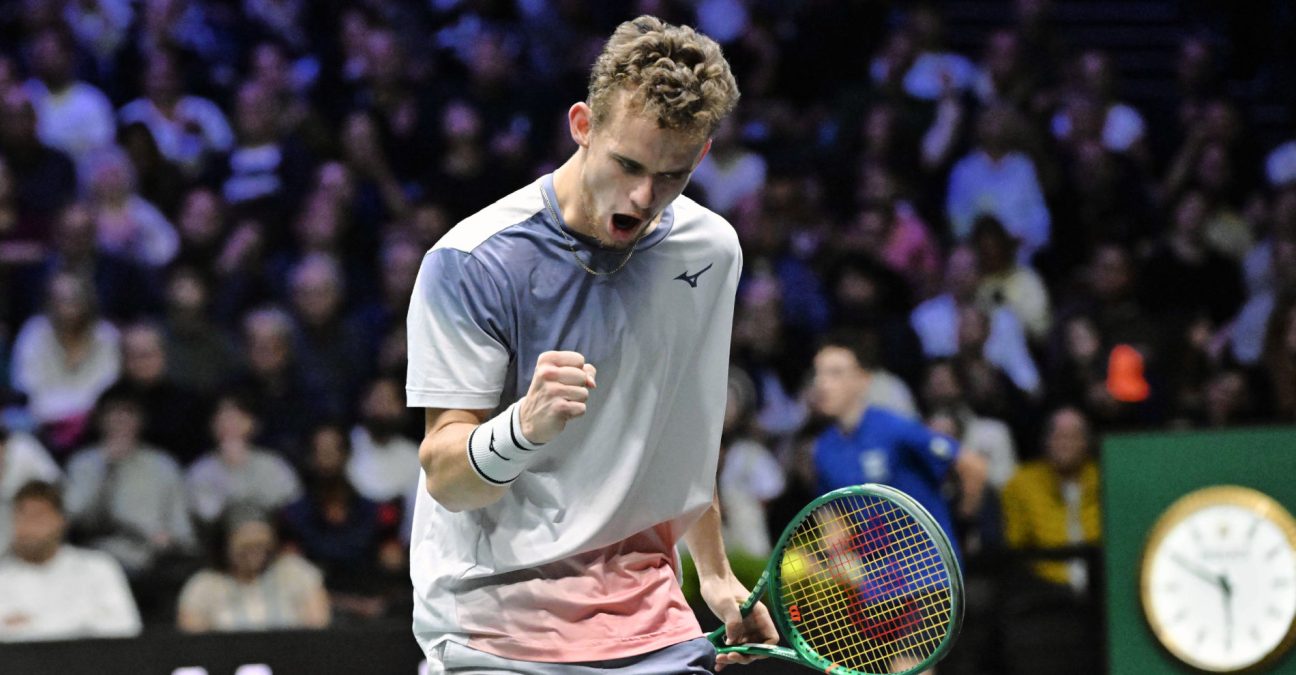 Lucas Van Assche, Rolex Paris Masters 2026 | © Chryslène Caillaud / PsNewz
On Saturday morning, Luca Van Assche wakes up with the first Masters 1000 semi-final of his career to play, at 2:30 p.m. at the Rolex Paris Masters, against Ben Shelton. The American, the third seed and a recent US Open finalist, stands 1.93 m tall, 15 centimeters taller than him. The two have never met on tour. But they have practiced together several times, and that’s enough for the Frenchman to know he has chances.
On Friday night, Van Assche did not talk as if the party was over. With the word “recovery” on his lips, he was less caught up in the excitement of a second marathon win in two days than focused on his plan to win.
“Shelton is going to have more power than me, but I’ll probably move better than him,” he said in French. “There are things he’ll do better than me, and things I’ll do better than him. And in the end, I hope it goes my way.” The 22-year-old did not hide behind the road already traveled to treat this run, the best of his professional career, as a goal in itself. “Of course, when you reach the semi-finals, the last four of a tournament, you hope to go all the way.”
A year ago in Paris, a loss in qualifying
A year ago, almost to the day, Van Assche left the same tournament after his first qualifying match. Ranked No. 170, he lost in the first round to Argentina’s Francisco Comesaña, 7-5, 6-1. A few weeks earlier, he had been ranked No. 238. Having broken into the top 100 at 19, the first of his generation in France to do so, he had no idea this could happen.
“Of course, when you go down the rankings, those are tough periods,” he said this week. “Especially because I was used (…) to not really facing any difficulties to progress. I got into the top 100 at 19, so it happened fast. I expected it to keep going that way.”
He had to drop back down to the Challenger circuit. “But the level on the Challenger circuit is very, very, very high, so I didn’t win much when I went back to Challengers. You lose on Monday, you wait a week, you start again on Monday…”
In mid-October 2025, Van Assche won the Olbia Challenger in Italy, beating Spain’s Pablo Carreño Busta in the final, 7-6 (5), 6-7 (1), 6-2. It was proof, back then, that he had asked himself the right questions and found the right answers.
“I was asking myself questions like: ‘What do I want to do?’, ‘How do I want to play?’, ‘How do I need to play to perform?’”



Doubt, then a love of tennis rediscovered
He sat down with his family, his team, and with himself. The answer came from a simple question.
“I was asked: ‘But if you were top 20, would you be asking yourself whether you love tennis or not?’ And in the end, I said to myself no. I realized that, for me, tennis was tied to the feeling of winning, and also that I loved it. And I just needed to love the way I play too.”
Former players helped him put things in perspective. “They also told me they all went through difficult moments, when they were asking themselves questions,” he explained on Friday. “I tell myself: ‘Well, actually, I’m not the only one.’”
He then started working with a new coach, Sébastien Villette. “We understood each other very quickly,” he said. “He’s someone who has a lot of confidence in me too, and of course that helps me.”
With him, he changed the way he sees the mental side, which he used to put above everything else. “In the end, tennis is really a racket sport where you hit a ball,” he explained on Thursday. “So yes, mentally, of course it plays a part, but it plays as much of a part as your technique, your tactics, your physical side.”
The breakthrough fits in one sentence. “I kind of stopped making excuses when I lost. When things went less well, it was always the fault of this or that. In the end, no. The player is me, actually.” That player’s intentions would have to make the difference.
Serve and forehand, the weapons of a transformed player
For a long time, Van Assche was described as a solid player, one of those who “keep the ball in play” and “are hard to beat.” He knows that is no longer enough.
“With matches and experience, you understand that putting the ball back in the court isn’t enough at this level,” he said on Thursday. “Tennis has really evolved now.”
The serve was the first project. Villette put it on the table from the start. “There were several areas of work when we started, a year ago, and the serve was one of them,” he explained on Thursday. “It took time, it didn’t happen overnight.”
Lorenzo Musetti felt it on Thursday. “He started to help himself with the serve, which is something that this surface helps a lot, and he was serving like 218, really, really, really strong serves that a little bit surprised me,” the Italian said.
The second project was the forehand, long his weak side. Van Assche says he now feels “almost even more comfortable” on that side than on his backhand, seen as his strong shot.
“Technically, I haven’t changed much,” he explained on Friday. His footwork changed, so he can be anchored and transfer his body weight into the shot. So did his intentions: “much more forward, much more aggressive.”
Paul-Henri Mathieu, France’s Davis Cup captain, has noticed. “I also find him very aggressive with his forehand, which wasn’t always the case,” he said on Friday. “On the backhand, there’s nothing to say, he doesn’t make many errors, he does pretty much what he wants.”
Four Challengers and a first ATP title in 2026
His 2026 season began with a loss in the final round of qualifying at the Australian Open, to Spain’s Rafael Jodar, 6-3, 0-6, 6-1. In late January, Van Assche won the Quimper Challenger, then the Lille Challenger in February.
In the spring, he returned to the top 100. In May, at Roland-Garros, he won a round in the main draw before falling in five sets to American Brandon Nakashima, 6-7 (5), 6-4, 5-7, 6-1, 6-3.
The Parma Challenger followed in June. In July, in Estoril, he won his first title on the ATP Tour.
On the way, he beat Russia’s Andrey Rublev, then ranked No. 14, 3-6, 6-3, 6-4 in the quarter-finals. In the final, he beat Belgium’s Alexander Blockx, 6-4, 4-6, 7-5. A fifth title of the season, at the Quebec City Challenger, lifted him to a career-high No. 40 on August 24. He arrived in Paris ranked No. 47.
In Paris, two revenge wins and a tactical battle
His week in Paris began with a 6-3, 7-5 win over Argentina’s Mariano Navone, his first main-draw victory in Paris. Then the revenge wins followed.
He beat American Learner Tien, the 15th seed, 7-6 (4), 6-4, a week after losing to him in Vienna, 6-3, 6-1. On Thursday, he knocked out Musetti 7-5, 3-6, 6-4 in 2 hours 38 minutes, after a 7-6 (5), 6-7 (7), 6-4 loss to the Italian in the quarter-finals in Lyon in late October.
On Friday, in the quarter-finals, he beat Australian qualifier Rinky Hijikata 6-4, 6-7 (4), 7-5 in 2 hours 44 minutes. He lost the second set in a tie-break and made a poor start to the third.
He then made the difference by reading his opponent’s game with the ease of a seasoned campaigner. “He started passing really well towards the end of the match,” Hijikata said. “He (…) came up with the goods when he needed to.”
For Mathieu, that is what sparked the win, with Van Assche trailing 2-0 in the third set. “He played better tactically than his opponent, who got a bit stubborn about coming in on Luca’s backhand, which wasn’t necessarily the right solution.”
The one running late, and the cruelty of tennis
In 2021, Van Assche won the Roland-Garros boys’ title, beating Arthur Fils 6-4, 6-2 in the final. Since then, he has often been the one running late. In the second half of 2024, as he dropped out of the top 100, Fils reached the last 16 at Wimbledon, then won titles in Hamburg and Tokyo. Giovanni Mpetshi Perricard also reached the last 16 at Wimbledon, as a qualifier, then beat Shelton in the Basel final in October, 6-4, 7-6 (4).
Villette refuses to measure this journey against anyone else’s. “It’s so hard to be No. 40 in the world in tennis, people don’t realize,” he said on Thursday.
As Van Assche prepares to face Shelton, Comesaña, the man who beat him here a year ago, is living a different week. The Argentine, ranked No. 54 in August 2025, is now No. 135. This week, in the first round of the Costa do Sauipe Challenger in Brazil, Italy’s Marco Cecchinato beat him 6-1, 6-7 (4), 7-6 (0) in 2 hours 55 minutes. In the final tie-break, Comesaña did not win a single point.
He stayed for several minutes, floored by the knockout, leaning against an advertising board, then sitting on his bench, pondering the difference between victory and defeat. In an image widely shared on social media, he was the last to leave the court, after the chair umpire.
A year separates these two images. Tennis is a sport of unmatched intensity and cruelty, in which Van Assche has found his path.
Rolex Paris Masters 2026: Van Assche and Shelton’s path to the semi-finals
Luca Van Assche d. Mariano Navone 6-3, 7-5
Luca Van Assche d. Learner Tien (15) 7-6 (4), 6-4
Luca Van Assche d. Lorenzo Musetti 7-5, 3-6, 6-4
Luca Van Assche d. Rinky Hijikata (Q) 6-4, 6-7 (4), 7-5
Ben Shelton (3) bye
Ben Shelton (3) d. Cameron Norrie 6-3, 6-4
Ben Shelton (3) d. Arthur Rinderknech 3-6, 6-4, 7-6 (5)
Ben Shelton (3) d. Tommy Paul (12) 6-4, 4-6, 6-3