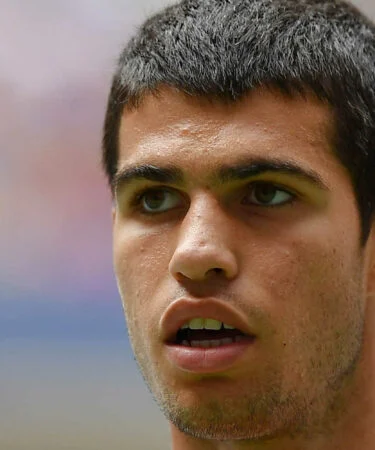
The battle of tennis geniuses: Alcaraz topples the king of Melbourne to become the youngest career Grand Slam achiever
Carlos Alcaraz made history on Sunday night, becoming the youngest man to achieve the Career Grand Slam by handing Novak Djokovic his first-ever defeat in an Australian Open final, winning 2-6, 6-2, 6-3, 7-5.
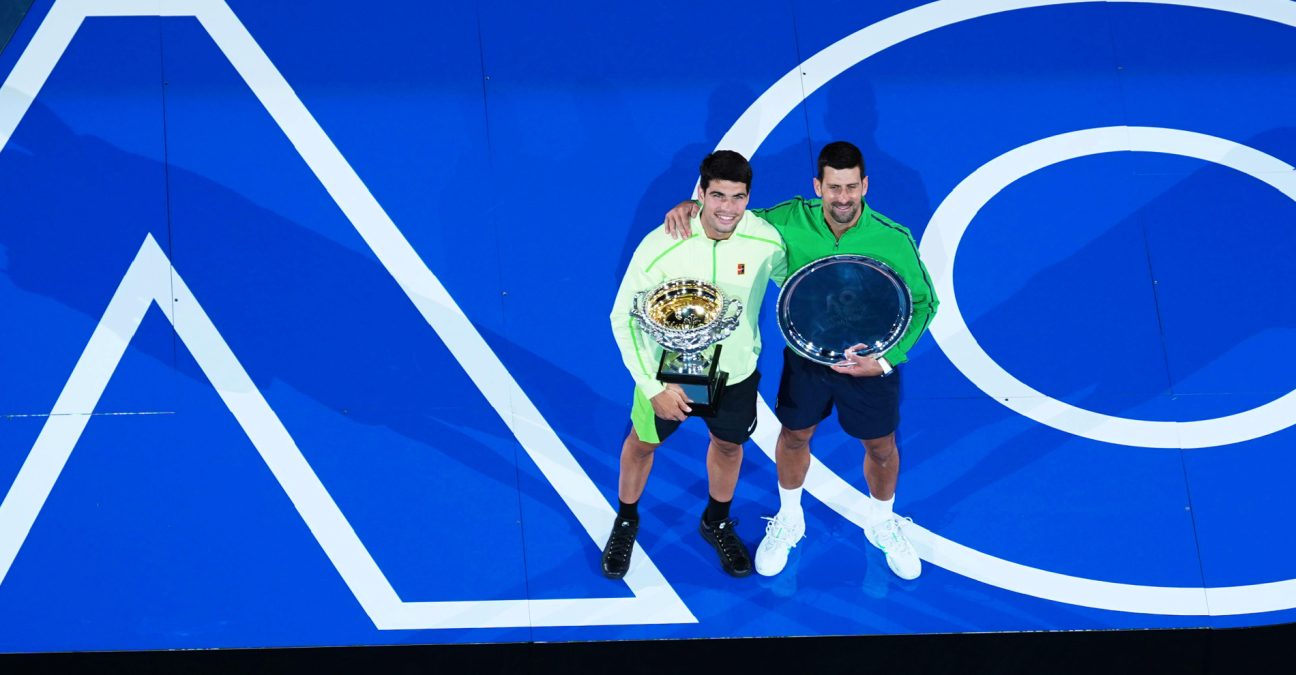 Carlos Alcaraz and Novak Djokovic, Australian Open 2026 | © AP Photo/Dar Yasin/ sipa

The Rod Laver Arena has witnessed countless miracles over the decades, but nothing quite like the seismic shift that occurred during the three hours and two minutes of the 2026 men’s singles final. In a collision of generations and styles, the 22-year-old world No 1 Carlos Alcaraz did what no man had ever done before: he defeated the ten-time champion Novak Djokovic in an epic Australian Open final.
By securing the 2-6, 6-2, 6-3, 7-5 victory, Alcaraz officially completed his Career Grand Slam, joining the most elite pantheon in sports history as its youngest ever member at just 22 years and 272 days old. “Historic, legendary”, Djokovic stated as early as the trophy ceremony. The Spaniard remains undefeated in the 2026 season, having now collected his seventh Grand Slam title and his first crown in the Victorian capital.
This final was always destined to be a “Battle of Geniuses,” a concept that the players urged us to forge in the fires of the semi-finals. To reach this stage, both men had to produce near-superhuman efforts that defined their respective brands of brilliance.
Djokovic, the No 4 seed, proved his tactical genius by ending Jannik Sinner’s 20-match winning streak in a grueling five-set masterclass that finished in the early hours of Saturday morning.
Meanwhile, Alcaraz demonstrated his physical and mental genius by surviving a five-hour and 27-minute marathon against the No 3 seed Alexander Zverev, eventually prevailing 7-5 in the fifth set after nearly squandering a two-set lead.

The master’s peak and the physical shift
The match began as a masterclass from the veteran. The 38-year-old Novak Djokovic entered the arena with a level of focus that suggested his 25th major was an inevitability. In the opening set, Djokovic was ultra-dominant, serving at a staggering 91% on his first delivery and committing only four unforced errors.
He outscored Alcaraz 29 points to 15 in that opening frame, moving with a fluidity that made the almost sixteen-year age gap between the players feel non-existent. For a moment, it felt as though Djokovic’s drive was at its peak and would carry him to yet another record-breaking night in his favorite city.
However, the physical demands of playing at such an extreme level against a relentless opponent began to take their toll. Djokovic’s bravery was at its peak, but as the match crossed the hour mark, he began to look his age for half of the encounter. His first-serve percentage plummeted to 56% in the second set, and the momentum shifted as Alcaraz began to assert himself.
The quiet confidence of the Spaniard turned into a roar as he reversed the point count in the second set, winning 29 points to Djokovic’s 16. During the transition, the world No 1 looked toward his box, perhaps recalling the words of his coach, Sami Lopez, who had remarked earlier in the tournament, “Carlos, if it were easy, I’d be out there playing.”
Youngest in history to sweep the majors
The drama on the court was interspersed with moments of levity that only true legends can provide. After a tense medical timeout where the physio attended to Djokovic, the Serb looked toward Rafael Nadal in the stands and joked, “Wanna play, Rafa?” It was an iconic moment between two of the greatest to ever pick up a tennis racquet, acknowledging the brutal intensity of the battle below.
Yet, as play resumed, the focus returned to Alcaraz’s historic pursuit. The fourth set provided the defining drama of the night. At 1-0, Djokovic faced a massive test of nerve, saving six break points in a single game to maintain his capacity to eventually prevail.
Djokovic refusing to fade
Djokovic refused to fade, pushing the young star to the brink at 4-4 where he got himself a break point opportunity. However, the Serb jinxed the chance with a mistimed forehand followed by an unforced error on the game point coming next for the Spaniard. It was a rare lapse from the master of pressure points, and Alcaraz did not hesitate to capitalize.
By completing the set of all four majors – the US Open (2022, 2025), Wimbledon (2023, 2024), Roland-Garros (2024, 2025), and now the Australian Open (2026) – Alcaraz has moved into history at a faster pace than any of his predecessors.
At 22 years and 272 days, he surpassed Bjorn Borg, who won his seventh title at 23, and Rafael Nadal, who reached the milestone at 24. Even the great Roger Federer was 24 years and 174 days old when he reached his seventh major.
Alcaraz’s victory signals a new era for the sport, one where the apprentice has finally, and definitively, become the master on every surface the world has to offer. Alcaraz has won seventh of the twenty major tournaments he played ; un unprecedented rate of 35% of wins. As he held his head in his hands on the court floor, the “tennis genius” from El Palmar confirmed that his reign has only just begun.