The art of suffering: How Carlos Alcaraz refused to break in Melbourne (as he always does)
Carlos Alcaraz stated that he never thought for a single second about giving up in his grueling semifinal against Zverev, literally or figuratively. Even the challenge of rebuilding his body before the final is one he has fully accepted.
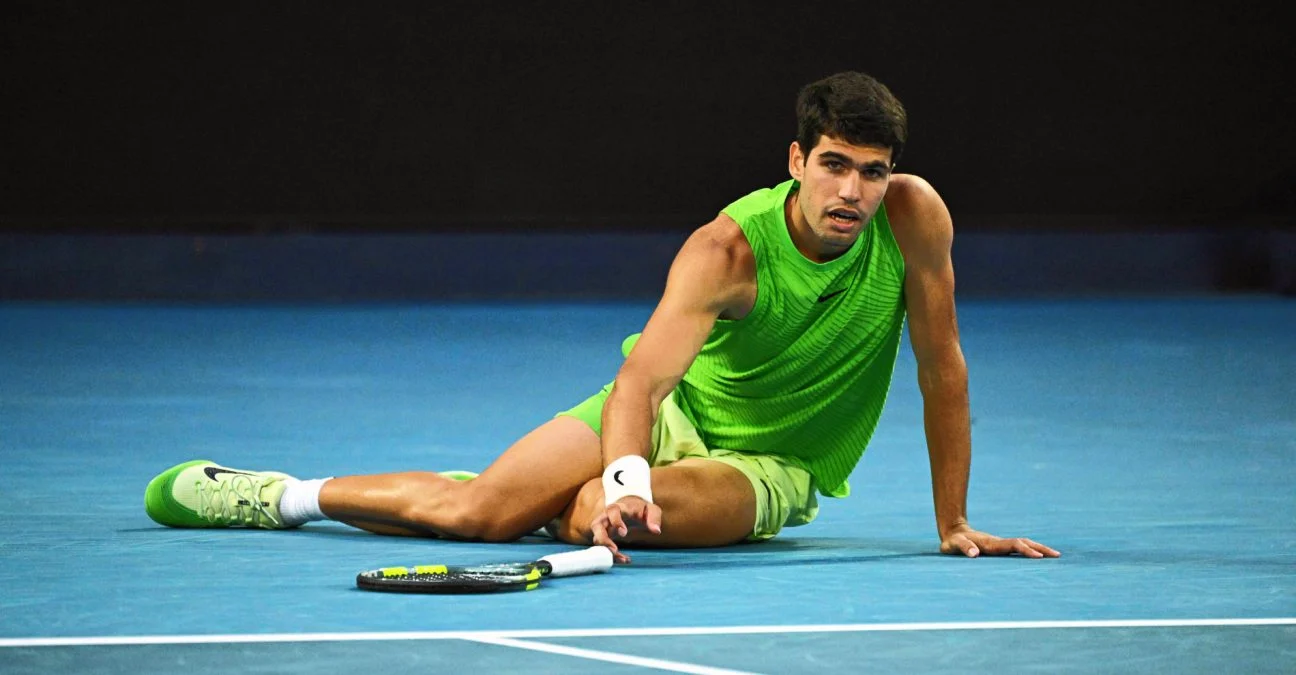 Carlos Alcaraz, Australian Open 2026 | © Imago / PsNewz

Carlos Alcaraz’s victory over Alexander Zverev was not merely a display of tennis brilliance; it was a doctoral thesis on the “never give up” mindset that has defined his rapid ascent to the summit of the sport.
At 22, Alcaraz has now reached the final of all four Grand Slam tournaments, but none required a more profound excavation of his mental and physical reserves than this Melbourne marathon. When Alcaraz’s body appeared to fail him in the third set, and his tactical lead evaporated into a grueling fifth-set decider, the Spaniard leaned into a philosophy he calls the “worth of suffering.”
Alcaraz has now won 15 of his 16 career five-set encounters. Since his lone five-set defeat to Matteo Berrettini in Melbourne four years ago, the Spaniard has reeled off 12 consecutive victories in deciding sets.
The Evolution of a Fighter: “I Just Hate Giving Up”
For Alcaraz, the ability to remain anchored in a match when the physical cost becomes almost unbearable is a learned discipline. He candidly admits that as a younger player, he lacked the emotional calluses required for these five-hour wars. « I just hate giving up. I mean, I just hate – I just hate giving up. Just how I could feel after all, you know, I just don’t want to feel that way, » Alcaraz explained following the win. He reflected on his youth, where “there were a lot of matches that I just didn’t want to fight anymore.”
This maturity has transformed him into a player who views every second of agony as a necessary investment. « Thinking about, okay, I could do it or I could do a little bit more or I could suffer a little bit more, that feeling, those thoughts just, you know, kill myself. Every step more, every just one second more of suffering, one second more of fighting is always worth it. »
This internal motor was most visible when Zverev served for the match at 5-4 in the fifth. While many would have succumbed to the exhaustion of having already played for five hours, Alcaraz produced a final burst of “lucidity,” breaking back and winning the final four games of the match.
Medical Drama and Physical Resilience
By the time he reached the final game, his movement, which had been “hobbled” in the fourth set, had returned to a level that allowed him to strike a scorching passing shot to seal the win. He acknowledged the toll, stating, « Obviously my body could be better, to be honest, but I think that’s normal after five hours and a half. »
Alcaraz now stands one win away from becoming the youngest man in the Open Era to complete a Career Grand Slam, surpassing Rafael Nadal’s record. His recovery over the next 48 hours will be the primary variable heading into Sunday’s final against either Novak Djokovic or Jannik Sinner. Alcaraz’s routine for the night included ice baths, contract therapy, and intensive physiotherapy to address the “tightness” in his adductor.
« I just did whatever it takes just to try to be better, to feel better tomorrow, he said. I’m going to have treatment and we will see. Hopefully it’s not going to be nothing at all, but after five-hours-and-a-half match and that high level of physically, I think the muscles are going to be tight, and I just got to do whatever it takes to be as good as I can for the final.» Including going to bed after the other semifinal finishes.