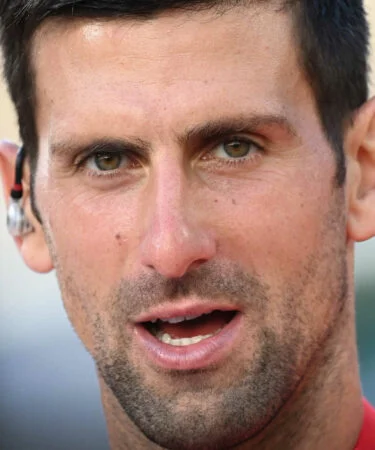
“Barely standing on my legs”: Novak Djokovic, 39, confirmed that physicality was a key factor of this early exit at Roland-Garros
Novak Djokovic, on his own account, did not have enough left on Friday. He described every place the fuel had run out: “I just ran out of gas, to be honest. I didn’t feel good at all on the court.” “It gave me more hope”, Djokovic added.
 Novak Djokovic, Roland-Garros 2026 | © Julien Nouet / Tennis Majors

Novak Djokovic walked out of Court Philippe-Chatrier on Friday night having lost a Roland-Garros match for which his own body, on his own account, did not have enough left. He had taken a two-set lead – the 290th time in his Grand Slam career he had been in that position, against just one previous defeat from it – and then proceeded to describe, in two languages over the next half-hour, every place the fuel had run out.
“I just ran out of gas, to be honest. I didn’t feel good at all on the court,” he said in the press room. He kept the phrase in service the whole way through. “I felt like I played every tournament in the last three months” he said, after having played only Indian Wells and Rome since the Australian Open in January.
Asked about the moment the match flipped, he placed it precisely. “The end of the fourth was my chance. I felt like the best chance, three-one, 15-40. He just played really good points… big serves in important moments.” Asked what he could have done differently in the fifth set: “Maybe my only fault was three-one in the fifth and serving, where I dropped the serve.”


“Unfortunately, it simply exhausts a person a lot.”
In the Serbian part of the conference, he gave the same account in a different register. “While I had good energy and fuel and while I was relatively fresh, everything was fine. Unfortunately, it simply exhausts a person a lot. He finally caught momentum with the break in the third, won the set, and there the crowd on his side woke up a little. A lot of energy was spent. It was really a lottery in some of those moments of the fourth and fifth.”
By his own description he was at one stage “barely standing on (his) legs… looking at the crowd and seeing them lift my spirits with something really magical.”

For two sets the read was the other way round. Fonseca had walked on court against a man twenty years older and been hit off it – and had said so. “He was destroying me,” he said of the opening hour. “If I hit it hard, the ball was coming back harder. If I would go higher, he was just doing dropshots and going aggressive.” His verdict on the 39-year-old in front of him at that point was unambiguous, and it lasted for two sets and into the third: “He’s 39, 40, and I feel like he’s 20. It’s just unbelievable.”
What changed, on his own account, was that the 39-year-old stopped feeling 20. Fonseca named the moment. “I figured out he was a little bit more tired, and that gave me a little bit more hope.” From there the match became, by his description, an exercise in pushing the older man’s serve. “I knew I was making good returns, leaving him really uncomfortable on his service games.”
Djokovic’s shoulder, mentioned briefly by a Serbian-room reporter, did not get the kind of answer the question wanted. “I’m trying to be optimistic now, but I came off court ten minutes ago, so you’ll understand that I’m currently very disappointed and that prevails as an emotion. I want to see tomorrow, a new day. We’ll see what I’ll do.”
He had said separately, in English, that this tournament had followed three months of being injured and trying to come back. “Considering I was injured for three months and trying to come back, and then going pretty much straight into a Grand Slam on this surface that was very demanding — for me it takes more time to get used to, trying to find my groove. But taking everything in consideration and all the circumstances, I think the level was really good. » It certainly was.