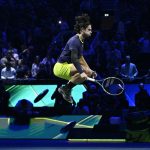
How technology is changing the way tennis fans follow and enjoy sports

From Melbourne’s animated feed to Wimbledon’s AI-voiced highlights and the US Open’s win probability, tennis broadcasts now start as data. With Kalshi signed as an official US Open partner, fans following a match face two probabilities built in opposite ways, and little to tell them which one to trust.
 Tennis illustration | © Sabine Morel
In January 2024, the Australian Open broadcast a Grand Slam as a cartoon. Tennis Australia streamed matches on YouTube with the players redrawn as blocky animated figures, and the recording of the men’s final drew almost 800,000 views, the Australian trade outlet B&T reported. It was quite a match to animate: Jannik Sinner came back from two sets down to beat Daniil Medvedev for his maiden major.
The cartoon looked like a gimmick. It also showed what the rest of the sport had been doing quietly: a tennis broadcast now starts as data and only later becomes pictures. Wimbledon had handed its highlight clips to a software voice the summer before. By 2026 the US Open app put a win probability beside the score, and the tournament had signed a partner whose customers trade on who wins. Each new layer asked fans to trust something built from numbers they couldn’t see, and most of the explanation came from whoever built them.
Melbourne’s cartoon was drawn from tracking data, not from video
AO Animated wasn’t a filter laid over footage. Sports Video Group described it during the 2025 tournament as a YouTube stream fed by player and ball tracking from 12 cameras, each capturing 29 points of the human skeleton at 50 frames per second, which graphics engines turned into cartoon players. Josh Lee, Tennis Australia’s head of broadcast and media operations, said a “talented internal team of innovators” built the feeds with “real-time player- and ball-tracking data and Unreal render engines.”
The reason for building it that way was contractual. Front Office Sports reported that ESPN holds the US rights to the tournament, and that the animated workaround let Tennis Australia grow its audience on YouTube without breaching its broadcast deals. The feed ran about two minutes behind play and was synced to the live commentary, the crowd and the chair umpire’s calls.
Machar Reid, Tennis Australia’s director of innovation, didn’t oversell the result. Limb tracking meant “12 cameras trying to process the silhouette of the human in real time,” he told The Guardian, as B&T relayed it, and the system still couldn’t render hands: “we don’t have fingers.” Front Office Sports noted that the avatars weren’t perfect replicas, though their clothing and headwear matched the real players’.
The workaround turned into something broadcasters wanted
The audience grew in year two. By Tennis Australia’s count, reported by Front Office Sports and Sports Video Group, AO Animated drew more than 950,000 views over the first four days of the 2025 event, against about 140,000 for the same stretch a year earlier. Rights holders noticed. Eurosport and beIN Sports added the feed to their own streaming services, and Lee said that by week two Tennis Australia was supplying it to three broadcast partners.
By 2026 the cartoon sat inside the rights system it had been built to get around. The tournament’s own broadcast release that year listed AO Animated as available through ESPN, Eurosport and Stan Sport, and called it a “mixed-reality experience.” The same release announced the event’s first continuous 24-hour world feed, which it said added more than 180 hours of content for broadcast partners.
Players were split. Carlos Alcaraz told the Associated Press the animated version was “a good alternative,” while Leylah Fernandez found the more accurate avatars “funny and weird.” Reid conceded the obvious: “Clearly, it’s not for everyone.” The numbers deserve the same caution. They came from the tournament, and they counted views, which say nothing about how long anyone stayed.
Tiley’s first US Open as USTA chief signed the market that prices its matches
The executive who ran Melbourne through those experiments moved to the US Open in 2026. Tennis Majors reported in February that Craig Tiley, Tennis Australia’s chief executive since 2013 and the Australian Open’s tournament director since 2006, would become chief executive of the USTA. The Block, citing Front Office Sports, reported that he took office on July 20 and played a major role in the deal that followed weeks later.
That deal made Kalshi the Official Prediction Market Partner of the US Open. Sports Video Group reported on September 1 that the multi-year agreement began with the 2026 singles main draw and gave Kalshi a presence on the tournament’s digital platforms and on-court signage. Kalshi said its tennis trading volume was up 25 times year over year. The two sides set an integrity framework restricting markets tied to umpire decisions and code violations, and Tiley said the deal let the tournament “pioneer that next generation of fan engagement while ensuring the integrity of our sport.”
It came together fast. Per The Block, the USTA had planned to consider prediction-market partners for later years, and the agreement wasn’t finalized until qualifying ended. Front Office Sports reported that rival prediction-market platforms were barred from advertising at the venue and on ESPN’s broadcasts; the USTA and ESPN didn’t immediately comment. A Kalshi blog post pricing the women’s draw, published earlier on the day the deal was reported, still carried a line saying the company was “not affiliated with the US Open or WTA.”
That post shows what the new number looks like up close. Traders had Aryna Sabalenka at 23%, Coco Gauff at 16% and Iga Swiatek at 15% to win the title. Read plainly, the market gave the rest of the field a 77% chance against the favorite.
Two days before the deal was reported, a federal appeals court had sided with a state’s gaming regulators against Kalshi: the Ninth Circuit’s August 28 ruling, which The Block said conflicted with an earlier Third Circuit decision. Until the courts resolve that split, whether state gambling laws reach the company’s sports contracts may differ from state to state.
To the US Open, Kalshi was a partner. A gambling-review site files the whole category somewhere else. Among the reviews on playUSA, prediction markets have a heading of their own beside online casinos and social and sweepstakes casinos, under an introduction saying the team has “tested hundreds of platforms over every gaming vertical available in the US.”
Wimbledon gave its highlight clips a software voice and kept live commentary human
Before any cartoon or price, Wimbledon handed part of the commentary to software. IBM announced in June 2023 that generative AI built on its watsonx platform would narrate all of the tournament’s video highlights packages on the Wimbledon app and website, with captions fans could switch on or off. IBM said the model was trained in “the unique language of tennis” and called the feature a step toward commentary for matches outside the Show Courts, which already had live human commentators.
The limits were part of the story from the start. Tennis Majors reported at the time that the service would sit apart from the BBC’s coverage and be very limited, and that replacing commentators on live matches remained “a long way off.” The live microphones stayed with people. The software took the clips, and Usama Al-Qassab, the club’s marketing and commercial director, said that let fans hear commentary on “a wider variety of matches.”
Three years later the voice had become a conversation. IBM’s release for the 2026 Championships, played from late June to mid-July, described Match Chat, an AI assistant that answers typed questions such as “What has happened in the match so far?” from live match data, using models trained on Wimbledon’s editorial style. The release dated the partnership back more than 35 years, through the website’s launch in 1995 and the app’s in 2009. What it described was an assistant beside the match, not a machine calling it live.
The US Open app’s win probability came without a published track record
The tournament’s own app produced a second probability. IBM’s announcement for the 2026 tournament said Likelihood to Win, a feature it called popular, would run for all singles matches, calculating each player’s chance from current and historical statistics, expert opinion and match momentum, while a new Key Moments feature explained the swings. IBM and the USTA have worked together since 1992, the release noted.
Another feature echoed Melbourne. The same release introduced Serve Quality, built to track 21 points across each server’s body and racquet 50 times per second in all 254 singles matches, roughly 1.2 billion data points over the tournament. IBM called the method limb tracking, the technique Reid had described in Melbourne, aimed at analysis instead of animation.
IBM also offered evidence that fans want this. A Morning Consult survey commissioned by IBM found that 91% of global tennis fans surveyed use sports apps during events, and it reported high trust (64%) in AI-powered sports content. The counterweight is plain. The company selling the software commissioned the survey, the release gave no figure for how often the model’s favorite actually won, and “expert opinion” sits among the inputs, so the number isn’t pure statistics either.
Set that beside the market price and a fan has two probabilities for the same match, built in opposite ways. The app’s number comes from a model with no money at stake and no published accuracy record. The traded one comes from people with money on it and an unresolved legal question over the product. Nothing on the screen says what to do when they disagree.
Following a match now means choosing which number to believe
Watching tennis used to take one act of trust, in the picture and the person describing it. A fan now makes several, and each needs its own question. Is the picture live, or rebuilt two minutes behind play? Did a person or a model trained on house style write the voice? Has anyone published the probability’s record? And the price comes from a product that a gambling-review site files beside casinos, with its legal status still in front of the courts.
None of that makes the new layers useless. AO Animated gave fans a way to follow live matches on YouTube that the rights deals otherwise kept off it, and Match Chat, in IBM’s description, spares fans a search through statistics across several screens. The habit worth building is asking what each number is made of and how old it is. Kalshi’s 23% for Sabalenka was a reading from the morning the main draw began, and it said nothing about the afternoon.
Every post on PlayUSA on X carries the minute it went out, and that stamp is the detail live numbers lack: the app’s probability and the market’s price can shift after every point, so a screenshot of either ages before it’s shared. The Kalshi agreement runs for several years, so the price is likely to be back at Flushing Meadows next summer, and the question of which number to trust will come back with it.




More tennis news
November 9, 1993: The day the great Bjorn Borg played his last-ever professional match


Taylor Fritz returns to ATP top 10 after Paris quarter-final run


Gauff survives missed match point to edge Pegula at WTA Finals

Noskova converts all four break points to beat Kostyuk in WTA Finals opener

Alcaraz on course for an indoor hat-trick: “Probably the best I’ve played since my comeback”