Auger-Aliassime brands tennis’s injury rule “a disgrace” after Davidovich Fokina timeout
Through to the Wimbledon quarterfinals, Félix Auger-Aliassime turned a winning press conference into a broadside against tennis’s mid-match injury rule, branding it “a disgrace” after Alejandro Davidovich Fokina’s timeout struck at a crucial part of the match.
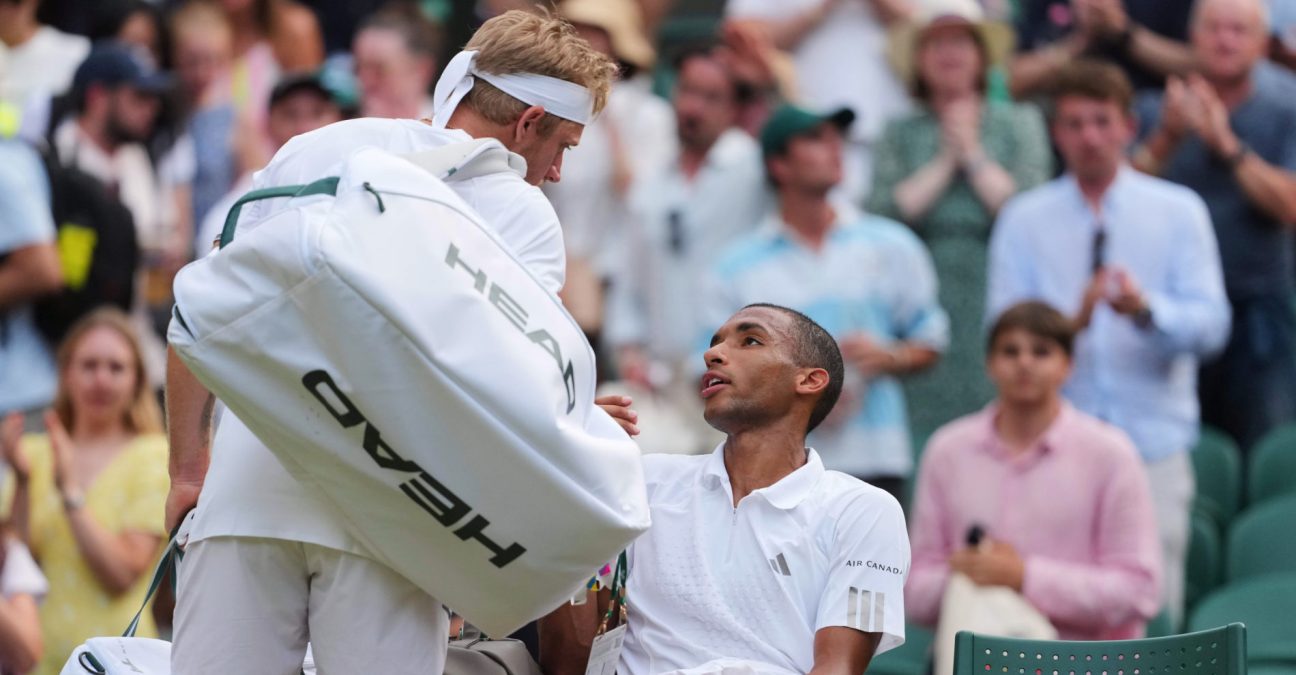 Felix Auger-Aliassime and Alejandro Davidovich Fokina, Wimbledon 2026 | © AP Photo/Kin Cheung/SIPA Press

Félix Auger-Aliassime reached the Wimbledon quarterfinals on Sunday, but as reporters insisted on the subject, he spent much of his press conference condemning the rule that nearly cost him the match, calling tennis’s mid-match injury protocol “a disgrace” after Alejandro Davidovich Fokina took a medical timeout at its decisive moment.
The Canadian led two sets to one and held two match points in the fourth when Davidovich Fokina crumpled with an apparent ankle problem and called for the physio. Auger-Aliassime failed to convert, double-faulted after the resumption and lost the set, before recovering to win 6-7, 7-6, 6-3, 6-7, 6-1.


“As long as the rule is like that, players will use it to their advantage,” Auger-Aliassime said. “To stop in the middle of an opponent’s service game and be able to call the physio, I think that’s a disgrace of a rule. I don’t see any other sport where you can do that. I mark my words: a disgrace of a rule.”
Felix: “he took advantage”
He offered his own fix. “If you’re hurt while your opponent is serving, the shot clock is on – you’re forfeiting every point until you can call the physio,” he said. “If the physio helps you recover, you play your service game. And if you’re hurt badly, then you retire.”
Pressed on whether Davidovich Fokina – not the author of the rule, Tennis Majors said to Felix – had abused it, Auger-Aliassime did not hesitate. “He took advantage – yeah, he took advantage,” he said. “You can play with words, but he took advantage. To the max!”
His frustration extended to the sport’s inertia on the issue. “The conversation is ongoing, but nobody’s taking decisions,” he said, arguing that players would keep using the loophole “properly, or in their own way” for as long as it existed.
What the rules say
Under the Grand Slam Rulebook’s medical rules (Section W.3), a player normally has to wait: the “Medical Evaluation” clause states a player may request the physiotherapist “to evaluate him/her during the next change over or set break.” The exception is the passage at the heart of Auger-Aliassime’s complaint. “Only in the case that a player develops an acute medical condition that necessitates an immediate stop in play” may a player be evaluated immediately, an acute condition being defined as “the sudden development of a medical illness or musculoskeletal injury… that requires immediate medical attention.”
A rolled ankle qualifies, which is why the rules permit exactly what happened: a stoppage in the middle of an opponent’s service game, followed by a Medical Time-Out “limited to three (3) minutes of treatment.”
The rulebook does carry anti-abuse safeguards, but both are discretionary. The Medical Time-Out section provides that “if it is determined by the Chair Umpire or Referee… that gamesmanship was involved, then a Code Violation for Unsportsmanlike Conduct could be issued,” and a separate penalty clause (W.3.e) warns that “any player abuse of this Medical Rule will be subject to penalty.”
Notably, the “forfeit points until the change of ends” model Auger-Aliassime proposed already exists in the rulebook w but only for muscle cramping, which a player “may forfeit the point(s)/game(s) needed to get to a change of ends or set-break in order to receive treatment” for, not for acute injuries.
Felix: “The same player, in Australia”
The Canadian was careful not to tar the whole tour. “It’s never an excuse to lose,” he said. “Ninety-nine percent of the players of my generation, at least the ones I mix with on tour, play with a lot of sportsmanship. We see two or three examples now and then, but it’s a shame – the rule needs to change.” He did, however, allude pointedly to “the same player, in Australia, curiously, with a sharp pain in the wrist at that moment” – leaving the implication of a pattern hanging.
There had been an exchange between the two men at the net after match point, which Auger-Aliassime declined to detail. “If he wants to come here i(n the media theater) and talk about it, he can,” he said. “But he knows my opinion.”