Djokovic’s road to his 25th Grand Slam: What needs to happen
Novak Djokovic is still chasing history, but time is no longer on his side. Surrounded by a fearless new generation led by Carlos Alcaraz and Jannik Sinner, the Serb’s pursuit of a record 25th Grand Slam may be his greatest challenge yet.
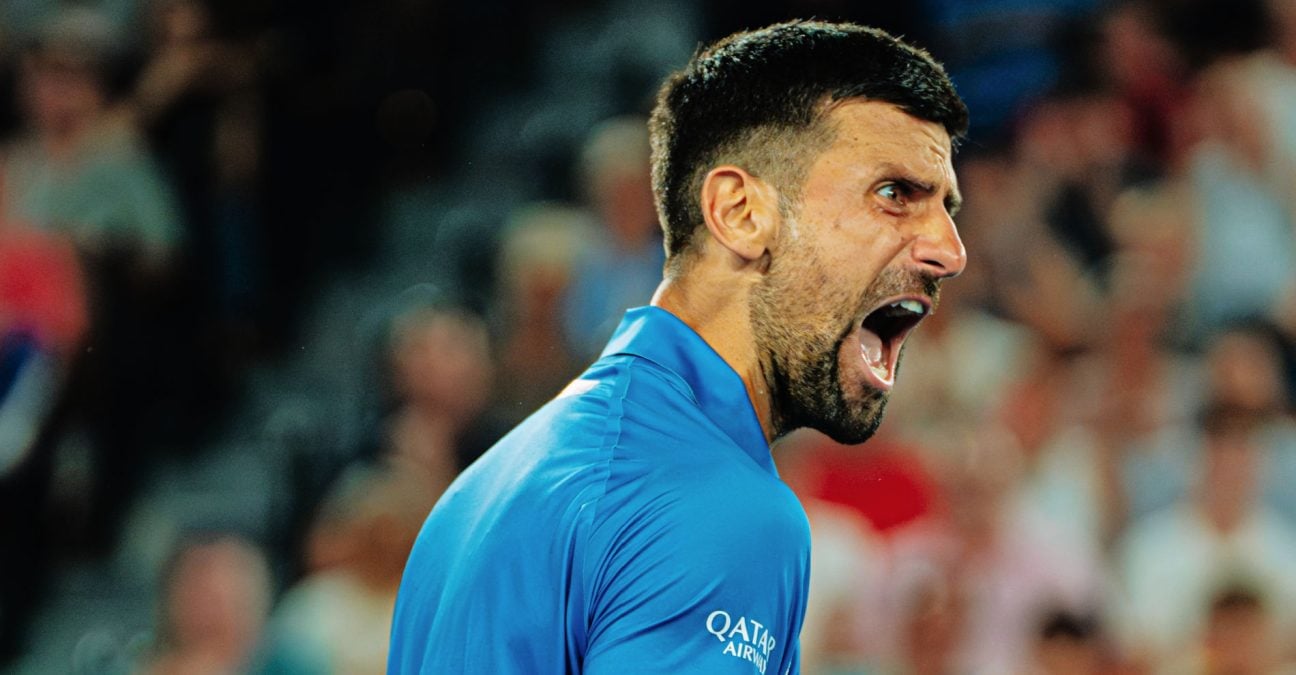 Novak Djokovic, Australian Open 2025 | © Tennis Majors / Julien Nouet
The 2026 tennis season has already produced the kind of moments that make you pause. Novak Djokovic, 38 years old and still ranked number three, was knocked out of Indian Wells by Jack Draper after a long, draining run to the Australian Open final, where Carlos Alcaraz eventually wore him down in four sets.
Draper’s win was talked about as a breakthrough for the young Brit, but it also pointed to something harder to ignore. Djokovic is no longer the immovable presence he once was.
His withdrawal from the Miami Open with a shoulder issue only deepened concerns about his durability in a sport increasingly defined by explosive athleticism and relentless physicality. This is the backdrop to his pursuit of a 25th major.
A legend still capable of brilliance, but now surrounded by younger, faster, hungrier players who never grew up fearing him. Messi felt it, LeBron has lived it, and soon Novak will understand—but there’s still plenty of energy yet for the Serb.
With odds of 20/1 from top-rated betting apps to win the French Open, a tournament he’s claimed three times, the question feels legitimate: Has he still got it?
His 2023 US Open triumph remains his last Slam, followed by a 2024 drought and 2025 semi-final runs that exposed endurance limits against the new guard. This positions him uniquely in his twilight, chasing a quarter-century of majors that would etch him as the men’s GOAT beyond Federer, Nadal, or anyone else who’s ever held a racquet.
The Weight of Legacy
Djokovic enters the middle of 2026 with 24 Grand Slam titles, 101 ATP singles titles, and a career defined by longevity, adaptability, and a ruthless ability to peak at the biggest moments. The numbers tell part of the story, but his legacy is built on something deeper: the ability to reinvent himself at every stage of his career.
From elastic defender to all-court aggressor. From the third wheel of the Big Three to the last man standing. His 2026 Australian Open run, including a semi-final win over Jannik Sinner before pushing Alcaraz to the limit in the final, showed that the competitive fire still burns as intensely as it did a decade ago.
The question now isn’t whether he is one of the greatest. That debate is settled. It’s whether he can summon one more defining act when the margins are tighter than they’ve ever been.
The pursuit of 25 carries weight beyond just another number. It would represent a quarter-century of Grand Slam excellence, a mark that might never be touched again. But legacy concerns can become a burden in themselves, tightening the shoulders in crucial moments and adding pressure where none is needed.
A Young Man’s Game
Alcaraz and Sinner have dominated the recent Grand Slam landscape, flipping head-to-head narratives and thriving in five-set marathons that once belonged to the older generation.
Alcaraz now has seven Slams, including a completed Career Grand Slam. Sinner has multiple majors and has firmly established himself among the sport’s elite. They’re dominating in a way that suggests the sport has genuinely moved on from a bygone era.
Draper, Jakub Menšík, and others are no longer intimidated by the aura that once surrounded the Big Three. They grew up watching Djokovic’s matches on YouTube, not experiencing them as unbeatable forces.
The mystique has faded, replaced by respect without fear. Djokovic’s challenge isn’t that he has declined dramatically. It’s that the field has risen around him whilst his margins for error have shrunk considerably.
What Needs to Happen
The shoulder injury that forced Novak out of Miami underlined that durability, not talent, is his biggest opponent. He must find a balance between a lighter schedule and enough match play to avoid the rust that has crept into his early-season form.
He can no longer rely on grinding opponents down over two weeks. That approach worked when he was 28, but at 38 the body simply won’t allow it anymore. Shortening points through first-strike tennis becomes essential. Assertive net play, serve-plus-one patterns, and the disruptive drop shot must be deployed more frequently, mirroring the late-career adjustments that prolonged Federer’s competitiveness when age became a factor.
Roland Garros represents the most physically demanding challenge. Clay grinds down older bodies faster than any other surface, with long rallies and brutal best-of-five encounters taking their toll.
Everything must be calibrated toward peaking at Wimbledon. The grass at the All England Club still best suits his movement, return game, and ability to take time away from younger rivals. Roland Garros remains possible but physically punishing, making Centre Court the likeliest stage for history.
And at 38, the draw matters more than ever. Avoiding Alcaraz or Sinner before the semi-finals could be the difference between another deep run and another early exit in a sport that increasingly belongs to the young. That’s not defeatist. It’s a realistic assessment of where modern tennis has arrived.
The US Open remains the most unpredictable Slam for older players. Heat and physicality make New York brutal in late summer. A deep run is possible if the conditions favour him, but a title feels unlikely unless the draw collapses in extraordinary ways. The hard courts are unforgiving on ageing joints, and the night sessions can stretch matches deep into the early hours in ways that benefit younger, fresher legs.
The Last Dance
Novak’s pursuit of a 25th Grand Slam is not a foregone conclusion. It might not even be probable at this stage. But it remains possible, and in tennis, possibility is all any champion needs.
He’s defied expectations his entire career, from breaking into the Big Three duopoly to outlasting Federer and Nadal in the longevity stakes.
One more major would cement a legacy that’s already beyond dispute. It would also give him something nobody else in the men’s game has ever achieved. A quarter-century of Grand Slam excellence. The road is clear. Whether Djokovic can still walk it remains to be seen.

People in this post
More tennis news
Ben Shelton on defending his Montreal title: “The way you win matters to me”


August 14, 1996: The day a stunned Andre Agassi was defaulted for swearing at an umpire


Shelton defends Montreal crown, joins elite Open Era club with gritty win over Nakashima


Swiatek completes career sweep of North American swing with dominant win over Rybakina in Toronto

Rybakina and Swiatek both fight through to set up Toronto final decider