Gaudenzi on court speed: “It is the balance between entertainment and injuries”
The ATP Chairman said any change to a court improves one thing and hurts another. He said ten variables shape how a court plays, and that the tour is working on the data.

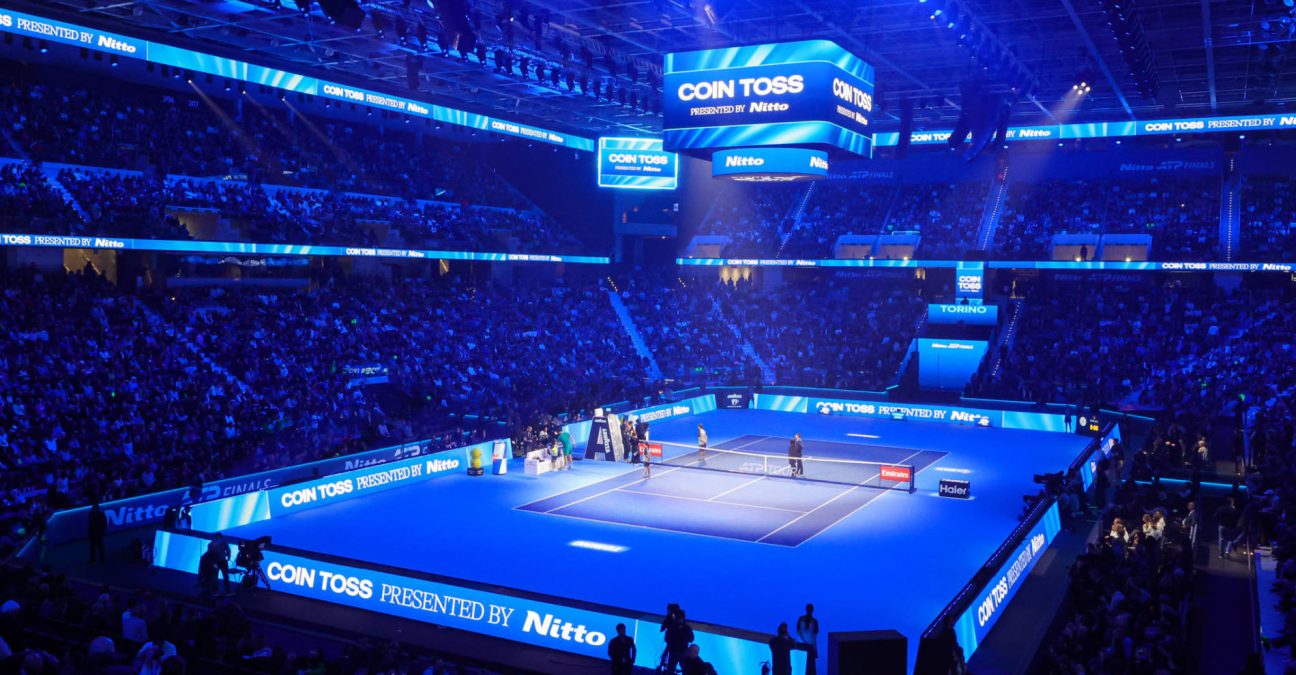 ATP Finals Center Court, 2026 | © Imago / PsNewz
ATP Chairman Andrea Gaudenzi said on Friday that court speed is a trade-off, summing it up as “you improve one and you make another worse.” He was answering a question at the Nitto ATP Finals in Turin about complaints that the courts are too fast and that only serves are seen.
The question follows a week of argument over the surface. Medvedev said after his 6-2, 6-4 loss to Alcaraz that indoor hard courts should not be slow. Mouratoglou used Zverev’s Tuesday win over Shelton to argue that tennis cannot go on like this.
Gaudenzi had already addressed injuries and his own painkiller years at the same press conference. His answer on court speed came later, in reply to a separate question, and he gave it in Italian.
Gaudenzi on court speed in Turin
The ATP Chairman first described the dilemma as two sets of complaints that pull in opposite directions. A court that is slower, he said, brings problems of its own.
“If it is too slow, we complain about injuries, matches that are too long, fatigue, rallies that are too long,” said Gaudenzi. “So it is the balance between entertainment and injuries.”
He then described how the situation has moved in recent years. He added that opinion is divided on the result.
Tennis has become homogenized, some say that is good, others not.
“In general, it has improved a lot in recent years,” said Gaudenzi. “Tennis has become homogenized, some say that is good, others not.”
Gaudenzi went on to list what decides how a court plays. He named the balls among several factors, said there are ten in all, and described each as hard to control.
“The variables are the balls, humidity, indoor, outdoor, altitude, the pile of the carpet,” said Gaudenzi. “There are ten variables, each time difficult to control.”
He ended by saying the tour is working on the question through data. He said the work is not straightforward.
“A lot of analysis, a lot of data, we are working on it,” said Gaudenzi, “but it is not simple.”