Best Underdog Runs in Australian Open History
Correction: Jo-Wilfried Tsonga, Aslan Karatsev, and Tommy Paul have been among the most astonishing contenders at the men’s Australian Open over the past twenty years.
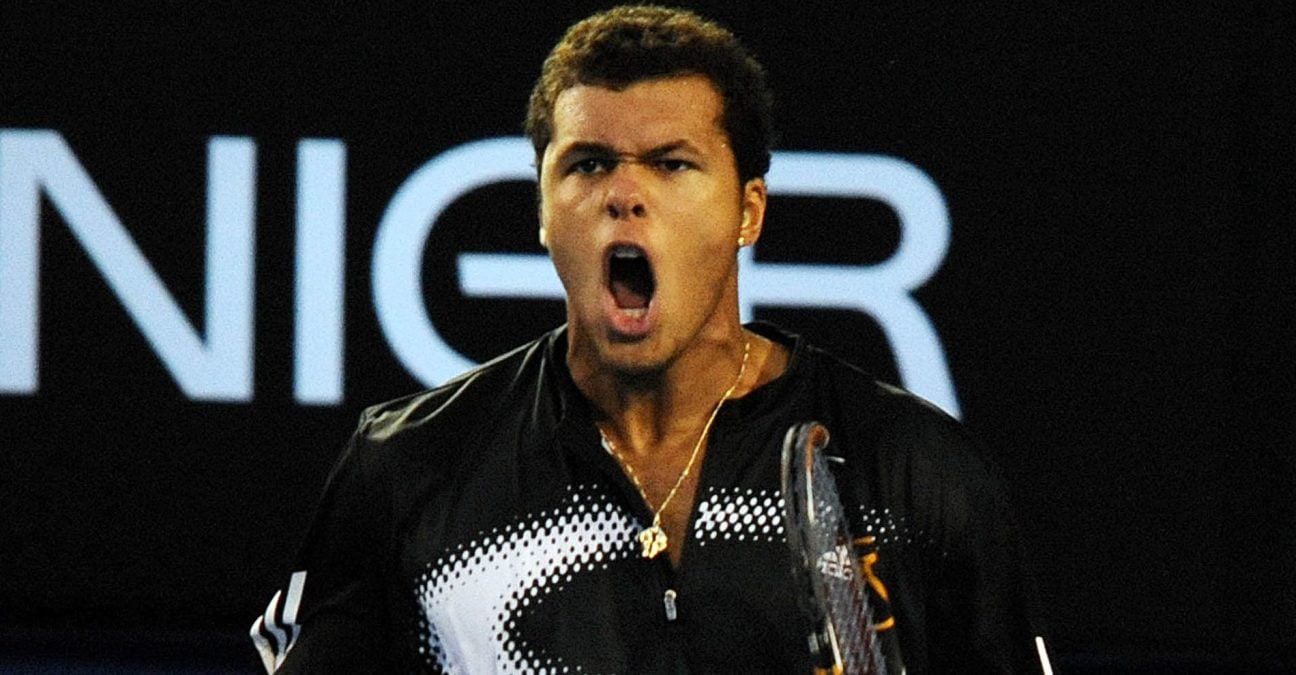 Jo-Wilfried Tsonga, Melbourne 2025 | © Fotosports / Bestimage / PsNewz

The 2025 tennis season has ushered in a new rivalry at the summit of the ATP Tour, a feud not seen since Novak Djokovic and Rafael Nadal were at the peaks of their powers throughout the late 2010s.
The two new kings of the court are, of course, Carlos Alcaraz and Jannik Sinner, superstars who carved up the calendar’s four Grand Slams between themselves this year. Sinner claimed the first in Melbourne with a riveting victory against Alexander Zverev, before going on to face off directly with Alcaraz in each of the next three finals, coming out as a 2-1 loser to the Spaniard across the series.
Almost predestined, the two would meet once more in the recent ATP Finals in Turin, with Sinner coming out on top in straight sets in front of his adoring Italian public. Now, all eyes turn to the Land Down Under for 2026’s curtain-raising Australian Open in January, and Sinner heads across the planet as the man to beat. He has romped to glory in each of the last two years in Melbourne, and he is aiming to become just the second man in the open era to complete the three-peat.
But while Sinner and Alcaraz find themselves positioned at the top of the betting charts as the favorites to meet in a fourth straight Slam final, underdogs have managed to steal the show down under on plenty of occasions before. Here are the best underdog runs in Aussie Open history.
Jo-Wilfried Tsonga
Sometimes, a star is born in a single, relentless fortnight. In January 2008, that man was Jo-Wilfried Tsonga—a 22-year-old Frenchman who, heading Down Under, was No. 38 in the world, without a single ATP title to his name, and overlooked on every expert’s draw sheet. His first act? Sending No. 9 seed Andy Murray tumbling out in straight sets. The message was clear: the “Tsonga Tsunami” was about to sweep the tournament.
But it wasn’t just the wins—it was the manner of them. Tsonga’s forehand became a wrecking ball that left even top 10 stalwarts like Richard Gasquet and Mikhail Youzhny searching for answers. And yet, it was the semifinals that brought the true shocker.
Prime time, Rod Laver Arena, world No. 2 Rafael Nadal on the other side of the net. What followed bordered on the surreal: Tsonga delivered a 6-2, 6-3, 6-2 hammering so one-sided that, even in this age of instant hyperbole, it was difficult to process. Nadal, usually indomitable, was left flat-footed and wide-eyed.
Tsonga would capture the first set of the final versus world number three, Novak Djokovic, leaving many to dream that the ultimate upset was on the cards. In the end, however, the eventual champion adjusted and ground through in four. But history is often written not by the title, but by the audacity of the run. In the afterglow of Melbourne, Tsonga’s journey stood as a triumphant eruption of joy and belief—a living, breathing reminder that, sometimes, the most dangerous players are those whom no one expects.
Aslan Karatsev
There are underdogs, and then there are statistical outliers—stories that border on the mythic. Aslan Karatsev’s 2021 performance didn’t so much blaze a trail as bulldoze established convention. At 27 years of age, ranked No. 114, and without a single main- draw Grand Slam win, the Russian found himself scraping through qualifying. He only snuck into the draw as a “lucky loser” and, for all but his inner circle, was an afterthought.
But the Australian Open occasionally deals out cosmic lottery tickets, much like the ones found on another Aussie favorite, Joe Fortune Casino, and their famous free-spin drop, which gives players a chance at hitting the jackpot for free. Karatsev unquestionably hit the jackpot and then some, seizing his risk-free opportunity with both hands.
His game? Fearless baseline striking, shots blasted ruthlessly wide and flat. The carnage began with the dismissal of No. 8 Diego Schwartzman in straight sets, a jaw- dropping upset. It continued with escape artistry—clawing back from two sets down against No. 20 Felix Auger-Aliassime, then dismantling Grigor Dimitrov in the quarters, all cool aggression and silent intimidation. If that’s not a jackpot win that should have online casinos taking notes, we’re not sure what would be!
Karatsev became the first man of the Open Era to reach the semifinals on Grand Slam main-draw debut—a 100-1 shot, by some bookmakers’ reckoning. Even Novak Djokovic, at the height of his powers, had to respect the effort. The fairytale finally ended at the Serb’s hands in the semifinals, 6-3, 6-4, 6-2, but Karatsev soared into the world’s top 50, collected the ATP’s Most Improved Player award, and—most importantly—reminded dreamers everywhere that Melbourne Park is the Slam where discretion is no match for the audacious.
Tommy Paul
By the mid-2020s, the tennis world had grown accustomed to American letdowns in Slam singles. Then, seemingly out of nowhere, Tommy Paul rewrote the narrative in 2023. At No. 35 in the world and tagged as “unseeded in spirit” if not in fact, Paul entered Melbourne’s maelstrom as a steady hand, not a gunslinger.
What followed was a slow-burning surge—a skillful blend of baseline accuracy, shot tolerance, and nerveless resolve. He pushed past Jan-Lennard Struff, claimed a topsy- turvy win over Alejandro Davidovich Fokina, and punched out No. 24 Roberto Bautista Agut. But the moment American fans dared to believe came in the quarters: Paul versus the dynamic Ben Shelton, the heir apparent of American power-tennis. Four tense sets later, it was Paul standing tall, his name splashed across the headlines back home.
In the semifinals, Paul met Novak Djokovic—Melbourne’s permanent landlord. The first set was close-fought; the rest, a masterclass by the nine-time champion. But the broader narrative outshone the loss: a new American face in the last four, a leap into the top 20, and, perhaps, a torch passed to a generation capable of rekindling U.S. Grand Slam contenders.


More tennis news
September 12, 1992: The day Stefan Edberg beat Michael Chang in the longest-ever US Open match


Shelton beats Tiafoe to become the first Black American man in a US Open final since Ashe


Zverev’s US Open final mission: “Not make the American dream come true”


Zverev survives two tie-breaks he was losing against Khachanov, to reach a third straight Grand Slam final

Fifty-eight years after Ashe’s triumph, two Black Americans meet for a place in the US Open final
