“I was astonished by the timing”: Spizzirri takes responsibility but questions Sinner’s heat-rule lifeline
Eliot Spizzirri left Rod Laver Arena with a mix of pride and profound disbelief on Saturday, about the heat-rule intervention that saved the cramping defending champion.
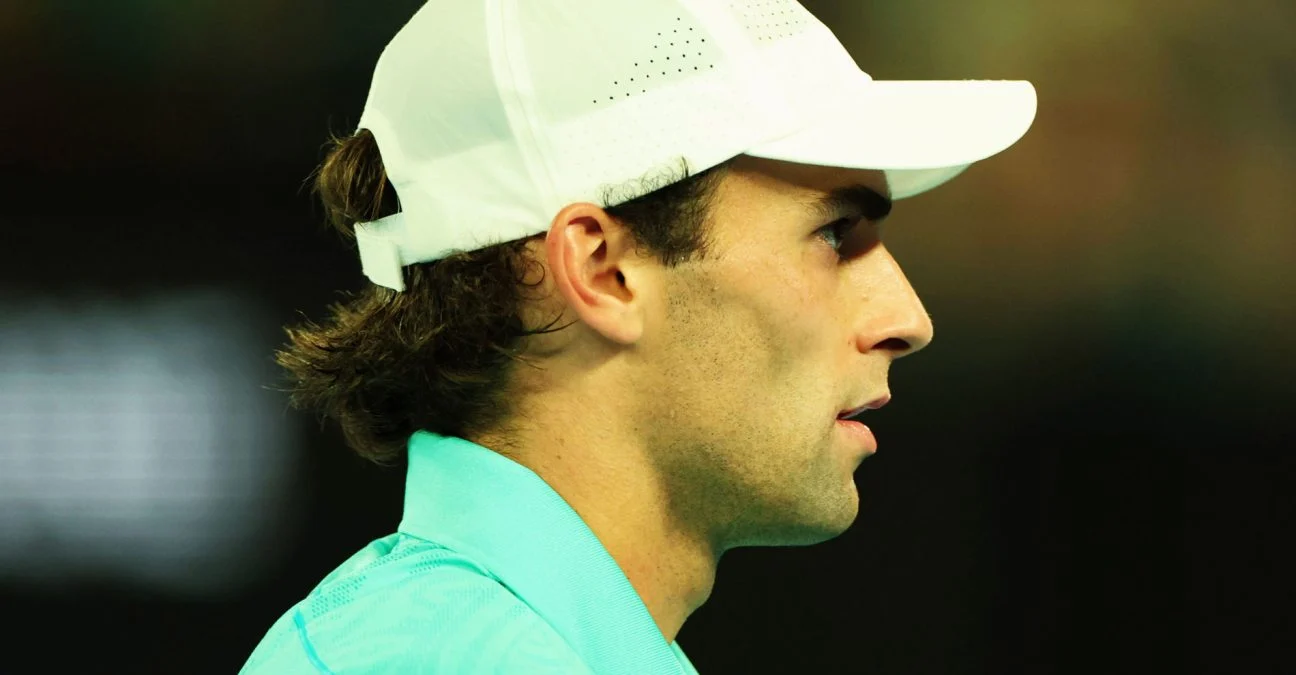 Eliot Spizzirri, Australian Open 2026 | © Marcin Cholewinski/ZUMA Press/SIPA Press)

The atmosphere inside Rod Laver Arena was as heavy as the 40-degree heat when the match reached its boiling point in the third set, on Saturday afternoon, match 2 on the Rod Laver Arena, Jannik Sinner, two-time defending champion vs. Eliot Spizzirri, the former University of Texas standout making his main draw debut in Melbourne.
Spizzirri hadSinner on the ropes. Sinner was visibly struggling, limping between points and battling severe cramps in his legs and arms, trailing 3-1 in the third set. It was at this precise moment that the Australian Open’s Heat Stress Scale (AO-HSS) hit the critical level of 5.0, triggering an immediate suspension of play to close the roof.
For Spizzirri, the sight of Sinner being ushered off the court for what would become an eight-minute recovery window was difficult to process. “I’m not going to sit here and blame the rules, because they are there for everyone, but I was just astonished at the timing of the scale hitting five exactly when it did,” Spizzirri said in his post-match press conference.
I’ve been working really hard for a moment like this, to play the best in the world on the biggest stage.
The American had spent the previous two hours grinding the world No. 2 into the blue hard court, only to see his opponent gifted a tactical and physical reset. “It felt like he was given a lifeline when he was physically finished, and as a player, that is a very tough pill to swallow when you have the momentum,” he added.
Spizzirri Taking ownership of the missed opportunity
Despite his clear frustration with the timing of the suspension, Spizzirri was adamant that the final result rested on his own racket. The world No. 85, who has enjoyed a meteoric rise through the ATP Challenger Tour over the last year, refused to use the heat protocol as a definitive excuse for the loss. “At the end of the day, I take full responsibility for the outcome,” Spizzirri noted, “I had a break in the third and I had chances in the fourth, but I didn’t execute the way I needed to when the conditions changed.”
The transition from the energy-sapping outdoor heat to the indoor conditions appeared to favor Sinner’s more rhythmic baseline game. Once the roof was closed and the air conditioning began to circulate, Sinner won five of the next six games to steal the third set. “The momentum shift was incredible, it was like playing a completely different person,” Spizzirri observed. “He went from barely being able to walk to hitting lines and serving at his normal speeds. I have to find a way to finish those matches regardless of whether the roof is open or closed, and that’s on me.”
The physical and mental toll of a Melbourne marathon
The match, which lasted three hours and 45 minutes, highlighted the extreme demands of the 2026 Australian Open. Spizzirri, who is known for his aggressive style and relentless work ethic, matched Sinner for the majority of the encounter, even taking the opening set 6-4. “I knew I had to make it physical, I knew I had to get him into those long rallies because the heat was the great equalizer today,” he explained. Spizzirri’s ability to stay focused while Sinner was hunched over and searching for shade in the first two sets was a testament to his own conditioning.
However, the mental hurdle of seeing a wounded opponent revived proved just as taxing as the heat itself. “It’s a joy to watch him play usually, but when you are on the other side and you see him struggling, you think the finish line is right there,” Spizzirri admitted. “I’ve been working really hard for a moment like this, to play the best in the world on the biggest stage. To have it turn on a dime because of a reading on a scale is something I’ve never experienced before.”
Looking ahead with a new perspective
Spizzirri leaves Melbourne with his ranking set to climb into the top 70 and the respect of the locker room. His performance against Sinner followed a grueling five-set victory over Wu Yibing and an upset of 28th seed Joao Fonseca, proving that his game translates to the highest level of the sport. “Win or lose, we’re going to learn from it, go back to the drawing board and try to get better,” the American said, echoing a sentiment he shared earlier in the tournament.
While the “Sinner lifeline” will likely remain the most discussed topic of the first week, Spizzirri is focused on the internal growth required to bridge the gap to the top 10. “I’m proud of how I competed, but I’m disappointed I didn’t close it out. I’ll be thinking about that 3-1 lead for a long time, but I’ll also be thinking about the fact that I proved I can go toe-to-toe with the defending champ,” he concluded. As the tournament continues into its second week, Spizzirri’s “astonishment” serves as a reminder of the fine margins and unpredictable elements that define Grand Slam tennis in the modern era.