“Always been an over-thinker”: Swiatek’s diagnosis and emotion after Miami early loss
After dismantling the first set without a flaw, world No. 2 Iga Swiatek collapsed against compatriot Magda Linette in Miami, ending a 73-match opening-round winning streak. In a raw press conference, she laid bare the loop she cannot yet escape: the more she thinks, the worse she plays – and she cannot stop thinking.
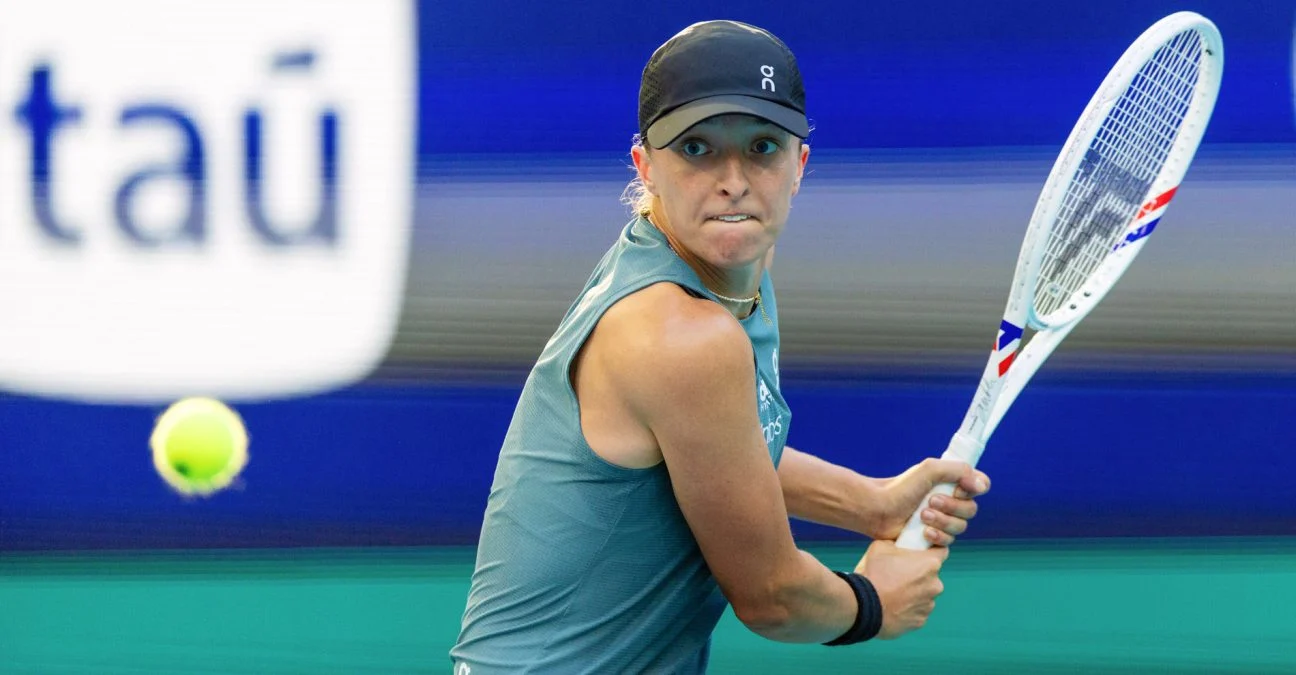 Iga Swiatek, Miami 2026 | © Miami Open


After dismantling the first set without a flaw, world No. 2 Iga Swiatek collapsed against compatriot Magda Linette in Miami, ending a 73-match opening-round winning streak. In a raw press conference, she laid bare the loop she cannot yet escape: the more she thinks, the worse she plays — and she cannot stop thinking.
There is a version of Iga Swiatek that wins matches on autopilot. She has described it herself: no noise, no second-guessing, just ball, racket, court. That version won the first set against Magda Linette with clinical authority at the Miami Open second round on Thursday — two breaks, 88 percent of first-serve points won, a display so ruthless it looked like a formality.
Then the thoughts came back.
World No. 50 Linette came from a set down to knock off the former Miami Open champion and No. 2 seed 1-6, 7-5, 6-3, ending a streak that had become one of the sport’s great statistical curiosities. Swiatek had won 73 consecutive opening-round matches on the WTA Tour, dating back to the 2021 WTA Finals. One compatriot, one Florida night, and it was gone.
Swiatek : “Hard for me to get rid of many thoughts.”
The scoreline tells the story of a collapse. The press conference told the story of its cause.
“I’ve always been an over-thinker,” Swiatek said in the aftermath, with a frankness that has become her hallmark in difficult moments. “Lately it has just been really intense. It’s hard for me to get rid of many thoughts.”
She then described the mechanics of her own unraveling with striking precision: bad decisions breed more thinking, more thinking breeds tension, tension stiffens the body, and a stiff body destroys timing. “It’s been like a circle that I’ve been going through on matches,” she said. “When you overthink stuff on the tennis court, you’re never going to be smooth, you’re never going to be loose, you’re never going to have a good timing. I played my best when I didn’t think much.”
She had felt it happening in real time and been powerless to stop it. “I stopped doing anything well tactically,” she said. “I had a problem with feeling my body well and that didn’t help as well.”
The second and third sets, a 7-5, 6-3 capitulation, were the visible result of an internal storm she could neither name in the moment nor contain on the court. “Unconsciously or consciously, it’s hard for me to say,” she admitted. “My tennis kind of collapses.”
A new trend – a bad trend
What makes this moment significant is not the streak, or even the defeat alone. It is the admission that the malaise has been building for weeks, perhaps months, quietly corroding the foundations of the most dominant player of her generation.
Maria Sakkari had already beaten her at a WTA 1000 event after dropping the first set earlier this season in Doha (2-6, 6-4, 7-5), Linette becoming only the second player to manage the same feat. A pattern is forming, and Swiatek is not pretending otherwise.
“My game hasn’t been good enough to have any expectations,” she said, cutting through any residual diplomatic filter. “I feel like I carry a lot of expectations and I can’t really fulfil them right now and I need to get rid of them.”
She spoke of carrying the weight of last year on her shoulders — the titles, the ranking, the reputation — like a debt she is struggling to repay. “Everybody knows I have a game to win tournaments. I just haven’t been showing that.”
“facing things that I never faced”
The emotional landscape she described is a strange and lonely one for a player of her stature. On one hand, a woman of immense experience who has won everything the sport can offer. On the other, someone navigating sensations she cannot quite recognise.
“I’m kind of facing things that I never faced,” the 24-year old said, “because I never felt things that intensely on court. I mean I did, but I was much younger, and it felt like a normal process. Now it doesn’t.” The word she kept returning to was ‘complicated’. Tennis, she said, feels complicated in her head right now — even though she knows, intellectually, that it is supposed to be simple.
There will be no single fix. When pressed on whether the solution was a small adjustment or a sweeping overhaul, she was unequivocal. “There’s no magic solution. You need to do it with small changes but consistently, and keep your discipline.” She is not burned out, she insisted — off the court, life feels good, the motivation is real. “The thing that would make me happy would be some positive emotions on the court, a few times in a row, so I know I have my game.”
The path back, in her telling, is not dramatic. It is methodical. Unglamorous. Built practice by practice, point by point, thought by thought. “I take full responsibility for how my game has been,” she said. “I can do things better. I just haven’t been doing things well for the last weeks, months. I don’t even know.”
She paused. Then, with the steadiness of someone who has climbed out of difficult places before: “I know I have it in me. I just lost it for a second.”
The question now is how long that second lasts.