“I want to blow apart this monopoly”: Angelo Binaghi sides with players against the Slams, and pushes his fifth-Grand-Slam dream
As Sabalenka and Gauff threaten a Grand Slam boycott over prize money, Italian Open president Angelo Binaghi has publicly backed the players — and used the moment to renew his campaign to turn Rome into a fifth Slam.
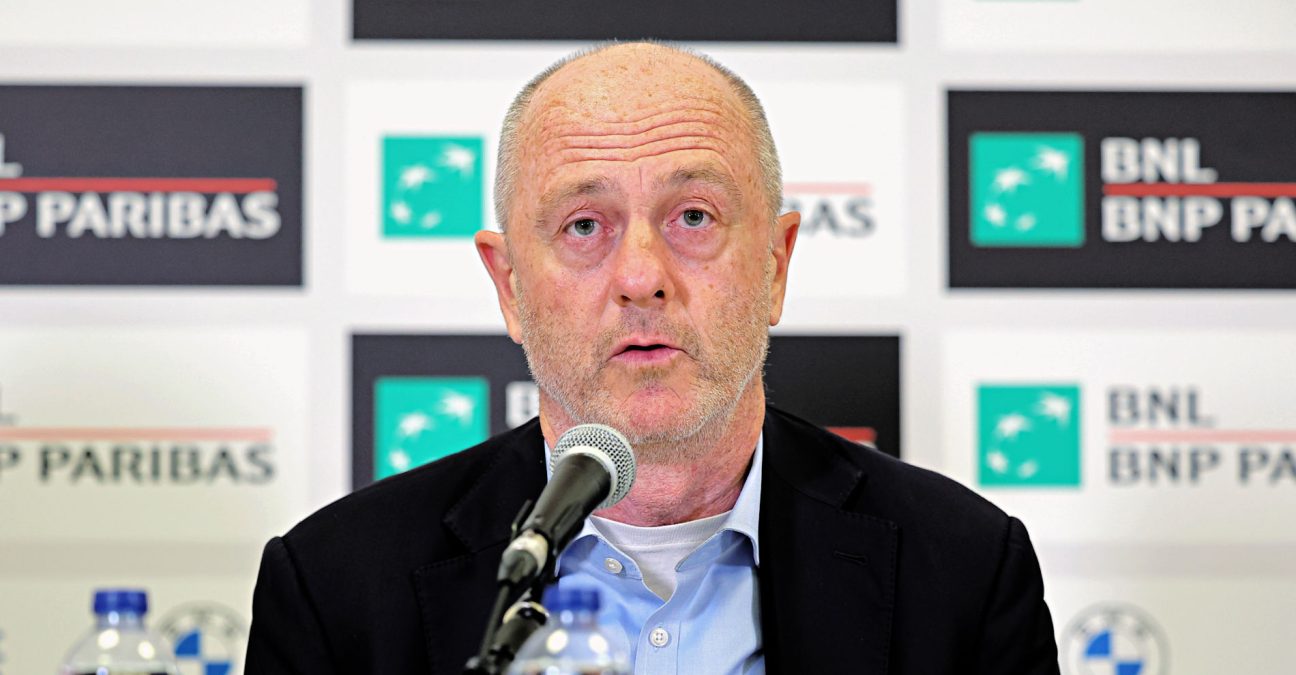 Antonio Binaghi, Rome 2026 | © FITP
The day after world number ones Aryna Sabalenka and Coco Gauff added their voices to a growing players’ revolt over Grand Slam prize money, the man running the Italian Open made a calculated intervention. According to a report by The Associated Press from Rome, Angelo Binaghi, president of the Italian Tennis and Padel Federation, sided with the players in unusually direct terms, and used the controversy to renew the campaign that has dominated his last twelve months: turning the Internazionali BNL d’Italia into a fifth Grand Slam.
Binaghi did not hedge. “The players have our full support,” he said. “It’s scandalous that we’re required by the ATP to share a bigger cut of the revenues with the players and the four Grand Slams hand out a smaller cut.” The four Slams pay out an alleged 14.3% of revenue in prize money, compared to 22% at ATP and WTA 1000 events like Rome.
The four nations have a huge amount of money to invest in their technical sectors that other nations don’t have. I want to blow apart this monopoly.
He went further, framing the imbalance as a structural distortion of the sport. “It’s shameful and creates competitive disparities, too, because the four nations [that organise the Slams] (Australia, France, United Kingdom, United States) have a huge amount of money to invest in their technical sectors that other nations don’t have. I want to blow apart this monopoly.”
Binaghi’s defence sits inside a larger ambition: to crack the Slams’ century-old cartel by adding a fifth member. According to AP, he has been campaigning for more than a year to elevate Rome to that status. Today’s intervention attaches the players’ grievance to his own cause – the Slams as a closed shop hoarding revenue, with the Italian Open as the natural challenger.
There is an obvious obstacle: space. The Foro Italico’s Campo Centrale holds 10,500 spectators and will rise to 12,400 once a retractable roof, due to be installed after this year’s tournament, is ready for the 2028 edition, AP reports. Roland-Garros drew nearly 700,000 spectators last year; Rome is hoping to clear 400,000 this year. Binaghi knows the gap is structural, and on Thursday he conceded as much.
“If we’re going to aim big, we shouldn’t focus exclusively on the Foro Italico.
“We’re open to organising a [fifth Grand Slam] anywhere in Italy, on any surface,” he said. And: “If we’re going to aim big, we shouldn’t focus exclusively on the Foro Italico, because there are a lot of issues here in terms of transport and temporary venues.”
Asked about the venue’s identity, Binaghi was unsentimental. “These days, the beauty factor is just added value; it’s not decisive. The people don’t come to see the statues anymore. They come to see Sinner, Musetti, Paolini and the other Italian players.”
“We’re experiencing a stretch of tennis in Italy that will be tough to repeat, because it also needs to be considered in comparison with the Italian soccer debacle,” he said, alluding to Italy’s failure to qualify for a third straight football World Cup.
The most quoted line of the day, though, was reserved for Sinner himself. Asked what would happen if the world number one won both Rome and Roland-Garros, the two big titles he has not yet claimed, Binaghi offered something close to a benediction. “Maybe I should step down,” he said. “If it happens, we’ll take stock of all the opportune and logical consequences.”
AP also notes a complication Binaghi did not address on Thursday: the Italian Open itself pays its men’s draw $9.6m and its women’s draw $8.3m — although next week’s women’s champion will pocket €1.055m, slightly more than the men’s €1.007m.





More tennis news
September 20, 1973: The day Billie Jean King defeated Bobby Riggs in the famous “Battle of the Sexes”


Ranked No. 449, Podoroska sweeps aside second seed Badosa to reach the first final of her career


Jovic returns to the Guadalajara final and a career-high No. 13, and will meet Stearns for the title

September 19, 1970: The day 15-year-old Chris Evert upset Margaret Court

Tsitsipas and Nakashima added to UTS Gothenburg field