Menšík collapses on court after surviving Navone in a fifth-set tie-break that ran to 13-11, the 26th seed unable to stand at the moment of victory
Jakub Menšík (No 26), 20, beat Mariano Navone 6-3, 2-6, 6-4, 1-6, 7-6(11) in 4h 41min – and collapsed to the clay at the moment of victory, unable to stand.
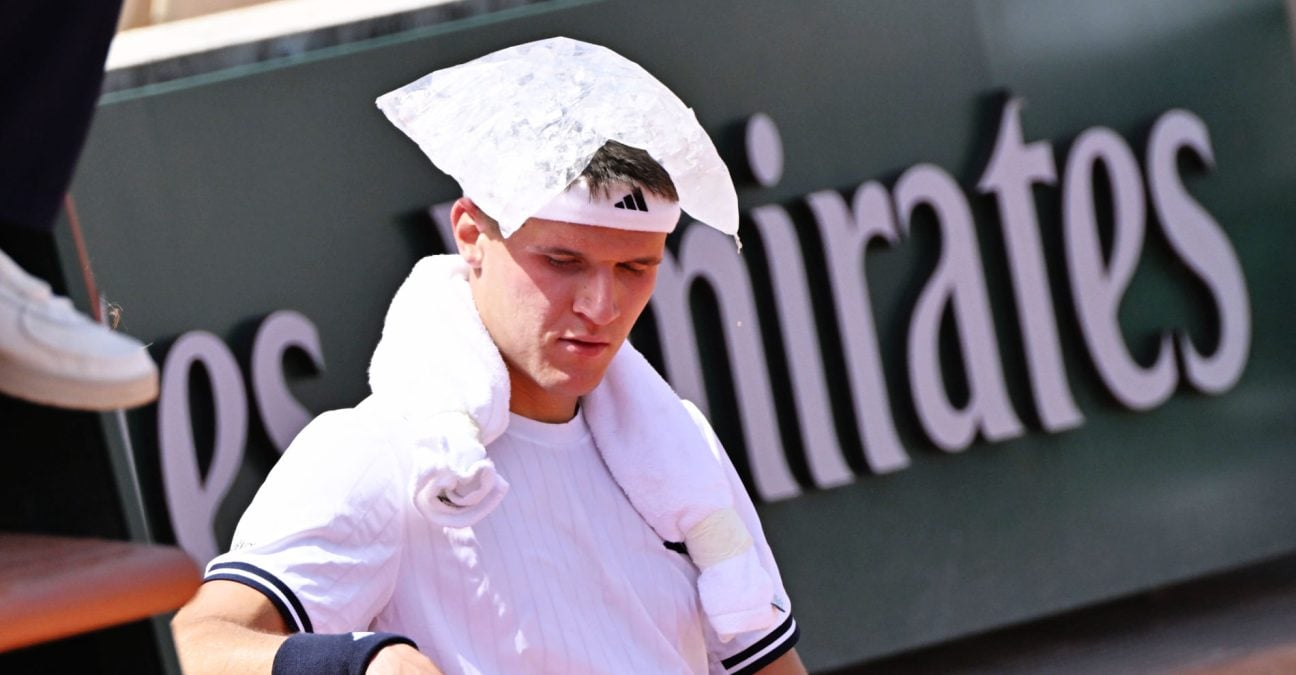 Jakub Mensik, Roland-Garros 2026 | © C. Caillaud / PsNewz

Jakub Menšík, the 20-year-old Czech 26th seed, beat Argentina’s Mariano Navone 6-3, 2-6, 6-4, 1-6, 7-6(11) on Court 12 on Wednesday afternoon to reach the third round of Roland-Garros. He then collapsed to the clay as the final point was won, unable to get back up. The match had run four hours and 41 minutes. The fifth-set tie-break alone, which Menšík won 13-11, had lasted close to 25 minutes.
He had been cramping through it. By the closing exchanges he was barely moving between points, lurching to the next position rather than running. Navone, the world No. 38 who had won the opening round here for the third straight year and arrived in Paris off a Bucharest title and a Geneva final, was the player still moving freely. The Czech was finding lines and angles from a body that had nothing left.
declining a wheelchair
When Menšík closed the tie-break, he went straight to the ground. He did not rise. Navone walked to Menšík’s side of the net and crouched to congratulate him there, rather than wait at the centre line. Doctors and Roland-Garros physios attended; ice was brought out. The match-point ovation continued through the medical timeout that followed. Menšík eventually stood and walked off the court under his own power, declining a wheelchair that had been offered.
The fifth set, for those who watch his record, was no surprise. Of the 24 Grand Slam main-draw matches Menšík has now played, nine – 37.5 per cent – have gone five sets. That is the highest five-set rate of any active player with at least 20 Grand Slam main-draw matches. The pattern fits a player whose physical commitment is unconditional and whose recovery has been a recurring theme of his early career. A year ago, in his only previous Roland-Garros, he led Henrique Rocha two sets to love before losing in five.
He has 48 hours to recover before facing Alex de Minaur, the Australian eighth seed, in the third round. The fitness question, in a tournament that grants no slack between rounds and arrives in the hottest week in years on the Paris clay, is the only one that matters now.