“Impossible to play them all” – Three days into his return, Alcaraz is already planning to miss tournaments
Carlos Alcaraz lost four and a half months of this season to a wrist injury, and he says he will now start taking time off by choice. The defending champion put a number on the problem in New York: 40 weeks of tennis a year if a player honors every mandatory event, and more injuries to come if nothing changes.
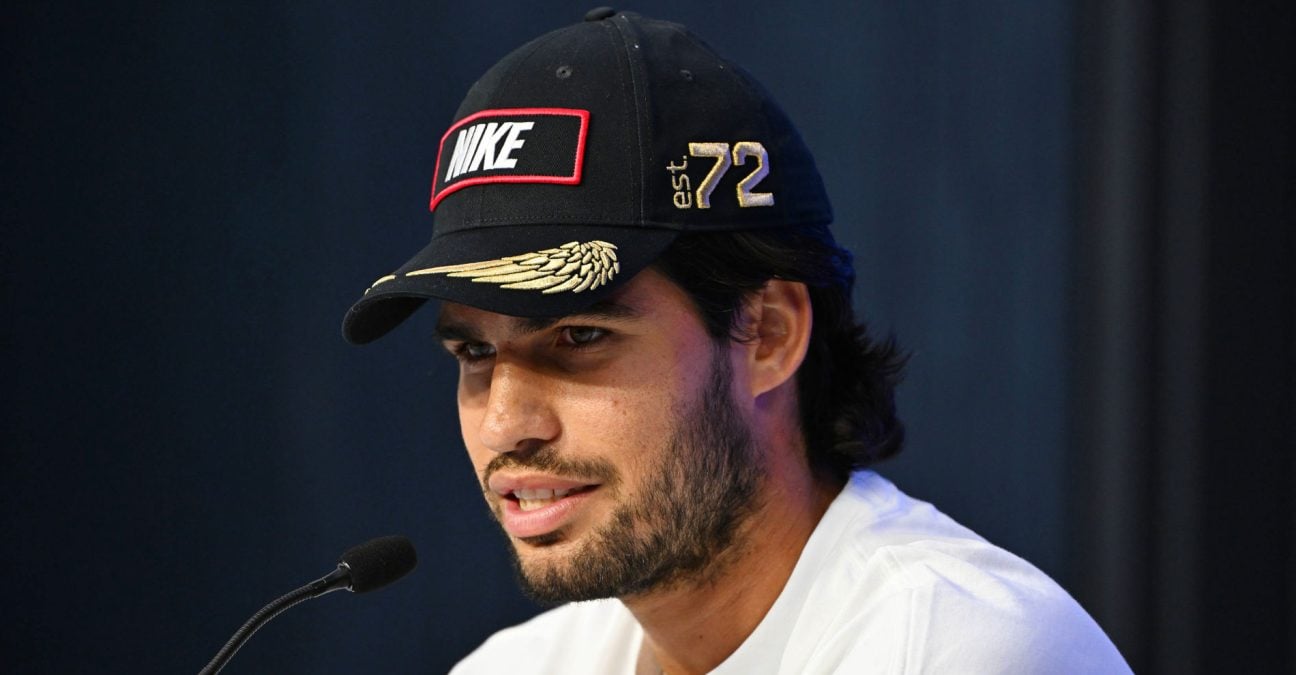 FLUSHING NY- AUGUST 28: Carlos Alcaraz is seen during Media Day at the USTA Billie Jean King National Tennis Center on August 28, 2026 in Flushing Queens.

Carlos Alcaraz has spent four and a half months of this season not playing, and in the early hours of Thursday, after reaching the third round of the US Open, he said he intends to do it again – on purpose.
The question that prompted it was whether the enforced layoff might turn out to be an advantage, given how many players have arrived at this tournament worn down. Rafael Jodar, the No. 12 seed, had gone out 6-2, 6-1, 6-1 to a lucky loser hours earlier.
Alcaraz declined the premise before accepting the conclusion.




“I took more than I wanted, to be honest, but seeing how tight is the calendar, obviously I don’t want to have this break because an injury,” the defending champion said. “But in the future, I’m going to take some breaks, some long breaks. Maybe not four months, but one month, two months, missing some tournaments, because it’s impossible to play them all.”
He then made the argument in numbers. “I think they adding more important tournaments. In a way they making us to play,” Alcaraz said. “You can decide your calendar, but there are some Masters 1000s, some Grand Slams, and we’ve been out playing 40 weeks if we got to play every mandatory tournament that the ATP required us to play. So it’s impossible, and we are seeing a lot of players getting injured, a lot of players getting tired. If they don’t do anything about it, we are going to see even more in the future.”
What the rules actually oblige a player to do
Under the 2026 ATP rulebook, a commitment player’s obligation is the singles event of every ATP Masters 1000 tournament for which he is accepted, the Nitto ATP Finals if he qualifies as a direct acceptance or is designated alternate, and four ATP 500 tournaments, one of which must fall after the US Open. Entry into the mandatory Masters 1000 events is automatic: players who qualify by ranking are entered by the ATP rather than choosing to enter.
The four Grand Slams are not ATP events and carry no ATP obligation, but no player at the top of the game skips them by choice. Several Masters 1000 tournaments have also been extended to run across roughly a fortnight rather than a week.
A player who decides in advance not to enter faces neither a fine nor a suspension. The cost is a reduction of up to 100% of his share of a $21.5 million bonus pool, plus a ranking penalty. The Masters 1000 and ATP Finals bonus pool for 2026 is $21,537,813, shared among the top 30 players in a points-based standings table, with $3,918,315 going to the player at the top of it. Missing one of those events, for any reason, cuts a player’s share by 25%. Missing two halves it, missing three costs 75%, and missing four removes it entirely.
Fines only begin if he pulls out late, and for a top-10 player a late withdrawal from a Masters 1000 costs $20,000, doubled to $40,000 if he would have been seeded. Alcaraz’s prize money ran to eight figures in both 2024 and 2025.
Alcaraz did not raise the topic himself. He was asked, and he answered it at the precise moment when the rest has left him fresher than anyone else in the tournament. “For me, you know, taking this break because an injury, it wasn’t that good, but what I say I’m going to take some breaks and missing some tournaments in the future, for sure.