US Open: Alcaraz concedes five games in three sets and moves past Nadal on an all-time list
Carlos Alcaraz lost the first set to Jaime Faria and won five of the next twenty-three games against him, coming through 4-6, 6-0, 6-3, 6-2 on his second night back from a four-and-a-half-month absence. The defending champion’s career Grand Slam win rate now trails only Bjorn Borg’s in the Open Era.
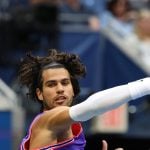
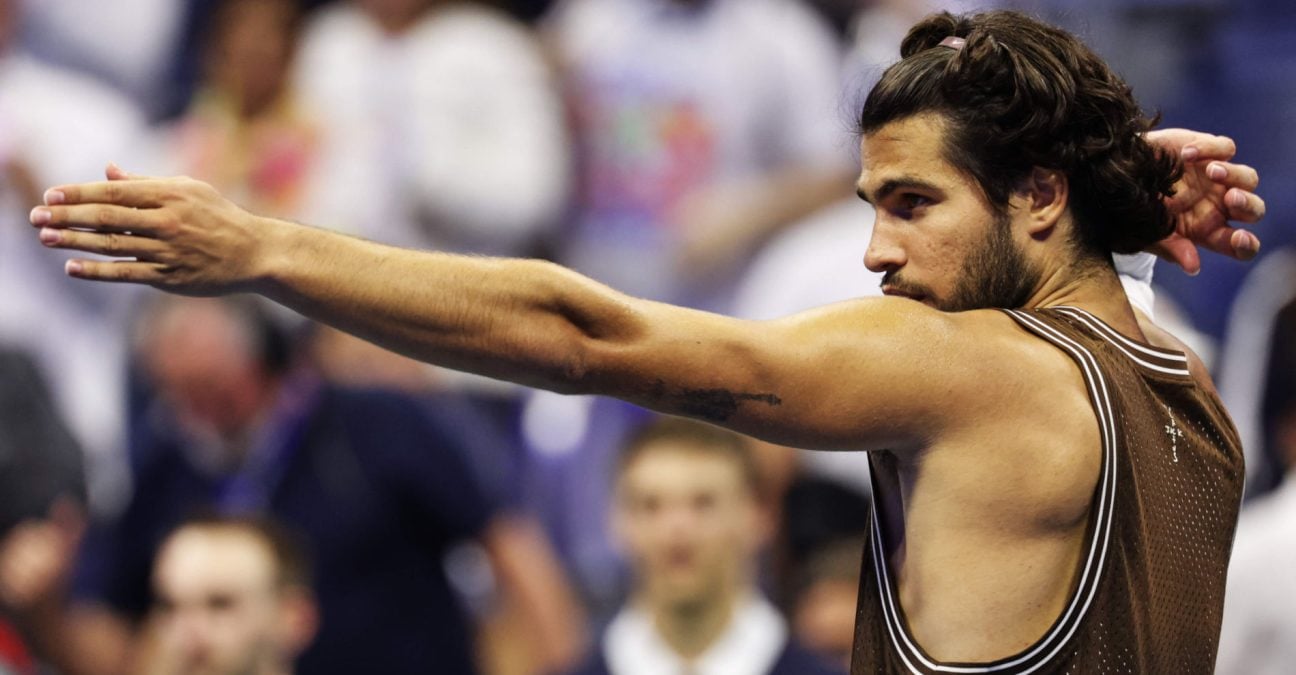 Carlos Alcaraz, of Spain, celebrates winning a match against Jaime Faria, of Portugal, during the second round of the U.S. Open tennis championships, Wednesday, Sept. 2, 2026, in New York. (AP Photo/Adam Hunger)/NYSS415/26246121916548//2609030524

Carlos Alcaraz lost the opening set of his second-round match on Thursday night and then gave Jaime Faria five games in the rest of it. The defending champion beat the Portuguese 4-6, 6-0, 6-3, 6-2 on Arthur Ashe Stadium to reach the third round of the US Open for the fifth time in six appearances.
The win takes his career record at Grand Slam level to 93-13. That is a win rate of 87.74%, which moves him past Rafael Nadal and leaves only Bjorn Borg ahead of him in the Open Era among players with at least ten matches at the majors. It is also his ninth consecutive win at this tournament and his 16th in a row at hard-court Grand Slams.
He marked the win with an archery celebration nobody had seen from him before.
He plays Wu Yibing in the third round, in a section of the draw that has already produced several of this tournament’s better stories. The 26-year-old Chinese, ranked outside the top 100, won the boys’ singles and doubles titles on these courts in 2017 and became junior World No. 1, then lost almost three years to injury between 2019 and 2022 and fell to No. 1,869 in the world. He came back through qualifying here in 2022 to become the first Chinese man to reach the US Open third round, losing to the World No. 1, Daniil Medvedev.


A streak assembled either side of four and a half months out
The first set turned on a single game. Alcaraz was broken at 4-3, the only break either man managed, and Faria served it out from there without conceding a game of his own all set. The margin elsewhere was almost nothing: 36 points to 33, 11 winners to 10, and eight unforced errors from Alcaraz against ten from the Portuguese. What separated them was the first serve. Faria landed 62% of his and won 81% of the points behind them, against 52% and 71% for Alcaraz, who was still finding the range on his second night back.
Alcaraz’s own account of the first set was about the conditions and a decision he took inside them. He had played his opening match in the afternoon and this one under lights, and the difference registered immediately. “Night session is totally different world than day session,” he said. “The ball becomes bigger. It’s tougher to move the ball around.” He had a break point early and did not convert it, and his response was the error. “After that, I just wanted to play short points, which was a mistake for me. I just needed to play patient, to play long rallies, three, four, five shots, and then go for it. But I kind of built the point from the first shots. I didn’t make it. So I would say that’s why he got the break and got the first set.”
The correction took one game. “After that, I realized what I had to do. I needed to be more patient, to build the points a little bit more since the beginning,” Alcaraz said. “I got an early break, which helped me a lot to play with more calm, and then I’m thinking more clear about everything. I would say that was the turning point.” Faria, who had held all five of his service games in the first set, did not hold one in the second.
What followed was 6-0, 6-3, 6-2, five games surrendered across three sets, and a match that stopped being a contest before midnight. The defending champion had wanted it shorter still, and said so. “I wanted to be quick, to be honest. I’m not going to lie,” he said. “But at the end, I realized that just playing four sets, it was really good for me, to test everything physically, to test my body, how I feel, and tomorrow how I’m going to feel after this match.”
US Open 2026, Men’s singles, second round
A. Zverev [1] vs Q. Halys – not played
A. Tabilo [25] vs A. Popyrin – not played
L. Darderi [21] vs D. Svrcina (Q) – not played
L. Musetti [13] vs D. Sweeny (W) – not played
Y. Bu (L) vs M. Zheng (W) – not played
Z. Svajda vs A. Gea (L) – not played
Z. Bergs [31] vs J. De Jong – not played
A. De Minaur [6] vs B. Van de Zandschulp – not played
F. Auger-Aliassime [3] vs K. Khachanov – not played
B. Bonzi vs I. Buse [32] – not played
J. Mensik [17] vs J. Rodionov (Q) – not played
L. Tien [14] vs G. Monfils (W) – not played
T. Fritz [9] vs M. Bellucci – not played
J. Struff vs F. Cerundolo [24] – not played
A. Blockx [28] vs M. Trungelliti – not played
F. Cobolli [5] vs T. Schoolkate (Q) – not played
D. Medvedev [7] d. S. Gorzny (W): 6-1, 6-3, 7-5
A. Rinderknech [26] d. J. Munar: 7-6(4), 6-2, 7-5
V. Vacherot [22] d. K. Majchrzak: 6-4, 4-6, 7-6(3), 6-2
F. Tiafoe [11] d. R. Sakamoto (Q): 6-3, 7-6(2), 7-5
A. Michelsen d. B. Nakashima [16]: 6-3, 6-4, 6-4
D. Merida d. A. Rublev [23]: 6-7(3), 6-2, 6-4, 6-4
T. Etcheverry [27] d. J. Fearnley (L): 6-3, 6-3, 3-6, 6-3
M. Navone d. M. Berrettini: 3-6, 6-3, 6-4, 7-6(4)
B. Shelton [8] d. H. Hurkacz: 6-3, 5-7, 7-6(3), 7-5
D. Shapovalov d. L. Van Assche: 6-0, 6-4, 7-6(7)
J. Lehecka [18] d. T. Samuel (Q): 6-4, 6-2, 6-4
S. Tsitsipas d. L. Harris (Q): 6-7(1), 6-3, 7-6(4), 6-4
A. Bublik [15] d. A. Mannarino: 6-3, 6-1, 6-1
T. Paul [20] d. D. Prizmic: 6-2, 6-3, 5-7, 6-4
Y. Wu d. J. Duckworth: 7-5, 6-3, 6-1
C. Alcaraz [2] d. J. Faria: 4-6, 6-0, 6-3, 6-2