Alcaraz and the art of becoming a complete champion with no secrets from himself
Australian Open in January, Paris two weeks ago, a first ATP Finals title within reach: Carlos Alcaraz is filling the gaps in his record, and with a hamstring scare and a serve he has learned to tame, he has used his week in Turin to get to know himself better, ahead of Sunday’s final against Alexander Zverev.

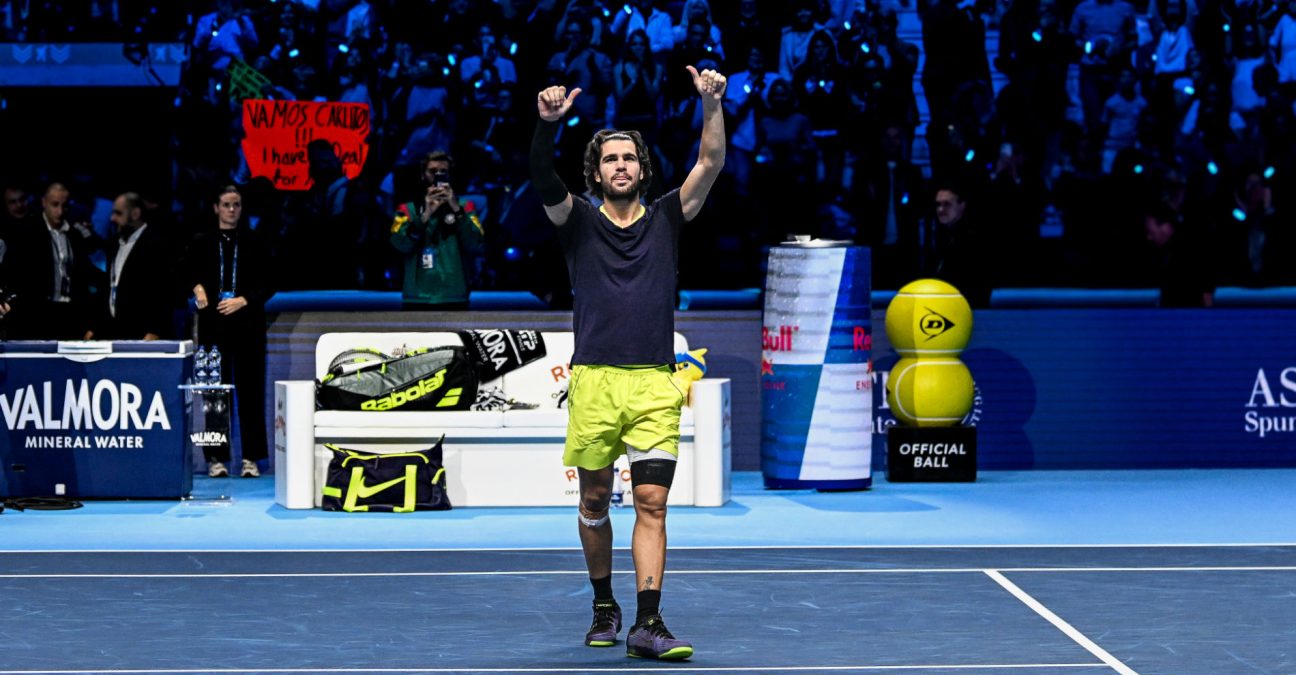 Carlos Alcaraz, ATP Finals 2026 | © PsNewz
Carlos Alcaraz has spent 2026 filling the gaps. The Australian Open, the only Grand Slam title that had eluded him, came in January. The Paris Masters, never won before, followed two weeks ago. On Sunday, the ATP Finals, the other big trophy missing from his record, will be within reach against Alexander Zverev.
But the Spaniard is not only adding trophies. His week in Turin, between an MRI on his hamstring on Thursday and his 3-6, 6-3, 7-6(1) comeback win over Ben Shelton in Saturday’s semi-final, has shown a player who keeps studying himself: how he serves, how he moves, how he wins. Here are the keys to a champion with fewer and fewer secrets from himself.
1. The two biggest indoor titles, which Nadal never won
Alcaraz long had a complicated relationship with indoor tennis. He only won his first indoor title in February 2025, in Rotterdam. Twenty-one months later, he is on the verge of owning the two biggest titles of the indoor season. After Vienna and his first Paris Masters two weeks ago, the ATP Finals would complete the set, something Rafael Nadal never managed. He has won 13 matches in a row, is unbeaten indoors this season (14-0) and has reached his seventh final of 2026, the most on the Tour.
The ATP Finals slipped away a year ago, when Jannik Sinner beat him in the final. A title on Sunday would make him the third Spanish champion of the event, after Manuel Orantes in 1976 and Alex Corretja in 1998.
Alcaraz does not hide what it would mean. “Obviously it would mean something very important for me, for my team. It’s one of the most important tournaments I have in the calendar,” he said in Spanish on Saturday. “Tomorrow is the last dance, after a wonderful week in terms of level and confidence.”


2. A physical warning as a lesson
On Thursday, after feeling something in his match against Daniil Medvedev, he had an MRI as a precaution and cancelled his practice. He has never revealed what it showed. But he quickly turned the scare into something useful. “I’m trying to learn from this moment, I’m trying to know myself a little bit better, and I think these kinds of moments help you a lot to know yourself much better,” he said on Friday.
The lesson is about how he moves. Against Shelton, he admitted he did not chase every ball as he usually does, and that this was no bad thing: “Maybe I don’t have to go crazy, I don’t have to run for certain impossible balls to be well physically.”
It leaves a question hanging over Sunday, perhaps the biggest one of the final: can you beat the world No. 1, at the peak of his form and at the event where he expresses himself best, without being able to go all out? Zverev, a two-time champion, has not lost his serve all week.
3. “I’m not a server”
Few players have served better than Alcaraz this week. He did not lose his serve in the round robin, has faced break points in just two of his 41 service games in Turin and, against Shelton, won 80% of the points behind his first serve, with 12 aces. Like others, he has made the most of a fast court.
Yet when he talks about his serve, he says the opposite of what the numbers suggest. Broken in his first service game on Saturday, he explained what had gone wrong. “He made a lot of great returns, and when that happens you feel more nervous,” he said. “I was seeing he was returning almost every serve, really well, really aggressive, and I really wanted to do more than I should have done.”
“I understand how I should serve. It’s when I’m relaxed, I do a really smooth movement and I accelerate. (…) After the second set, I realized that I just really need to do a really smooth movement, being relaxed. I’m not a server. I need to [dictate] the point from the baseline, so I have to realize that and understand that. Once I got it, I think [it] goes much better.”
In other words, the serve does not carry his game: it follows it. Alcaraz’s identity is to win points in the rallies. As long as he trusts that, he can relax on serve. When doubt creeps in, he asks the serve to do the work, and tightens up. A smooth, efficient serve is less a weapon in itself than a sign that he feels strong in the exchanges. On Sunday, against a Zverev who has not been broken all week, it may be the first thing to watch.
Matches like Saturday’s feed that self-knowledge. Of his duels with Shelton, now 5-1 in his favour, he said: “It is one of those matches that makes me be a better player, gives me a lot of feedback for the next practices on what I have to improve.”
4. “Every day is a new day”
The slow start against Shelton, after three convincing wins in the group, also produced a scene that does not look like him. At 3-1 in the first set, after a missed return, Alcaraz let out a rare cry of frustration aimed at himself, and a few games later exchanged disillusioned words with his box.
Asked about it in Spanish, he first pointed to his own mistake. “I took it for granted that I was going to play at the level I played yesterday, and I think that’s a mistake. Every day is a new day, every day is a different feeling, and you have to be focused to produce the level you want to produce.” The outburst, he said, was part of the solution: “Complaining, shouting, helped me. I had started tense, and I think that also helped me relax.”
It has always been said that Alcaraz wins when he enjoys himself on court. In Turin, he is learning something else: to enjoy the fight without playing his best tennis, which is also the mark of the great champions. “It’s just about to accept it, to enjoy playing this moment,” he said of the tie-break.


5. Winning the points that matter
“We have seen it, and all the greats have said it: you don’t win every point,” Alcaraz said in Spanish on Saturday. “At the end of your career, you will win maybe 54%, 55% of the points you play. The important thing is to win the important points, and how you feel, how you face them, is what really makes a great tennis player. That is what we try to work on, so that in those moments we are better than the others.”
The figure is no accident. In June 2024, in his commencement speech at Dartmouth, Roger Federer revealed that he had won almost 80% of his 1,526 matches, but only 54% of the points he played. “Even the best players in the world earn just over half the points they play,” the Swiss said then.
Winning the right ones is precisely what Alcaraz is known for: lifting his level when it matters. In Turin, he has kept doing it. Outplayed for a set and a half by Shelton, he won eight of the last ten points of the second set, then the third-set tie-break 7-1. All week, he has faced break points in only two of his 41 service games.
For him, winning that way is worth more than winning when everything goes in. “When you have had more problems and you solve them from a place of calm and, I would say, maturity, it is a different feeling (…), I think much better. I see that I am doing things well, and matches like today’s confirm it.”
On Sunday, he will face the world No. 1, who has not lost his serve all week. Alcaraz leads their head-to-head 7-6 and won their last meeting, in five sets in the Australian Open semi-finals in January.