The “sleeper” effect: How Carlos Alcaraz is building a first-class serve to serve his first-class ambition
While the world No. 1’s groundstrokes remain the most destructive in the game, it is the evolution of his serve into a “sleeper” weapon, modeled on the precision of Novak Djokovic, that highlights his relentless drive for improvement.
 Carlos Alcaraz, Australian Open 2025 | © Imago / PsNewz

Carlos Alcaraz is currently the best tennis player in the world, but he remains his own most demanding critic. After a 2025 season that saw him recapture two major tournaments and finish as the year-end No. 1, the 22-year-old spent his off-season focused on a single technical chink in his armor: the serve.
In his fourth-round victory at the 2026 Australian Open over the 19th seed Tommy Paul, the results were undeniable. Alcaraz is no longer just hitting the ball hard; he is learning the art of the “sleeper” serve, a term he uses to describe the deceptive, accurate delivery of his great rival, Novak Djokovic. Per the ATP’s serving rate system, the Serb is currently the sixth-best server in the world, with Alcaraz trailing closely at No. 10.
Precision Over Power: The Djokovic Blueprint
The most striking change in Alcaraz’s game this fortnight is a more abbreviated, rhythmic service motion. Eagle-eyed fans have noted the similarities to Djokovic’s stance: a higher, more upright starting position with the racquet raised to chest level before the toss and a visible increase in wrist flexibility. Alcaraz admits that the Serb’s accuracy is the new gold standard.
“For him, I would say he doesn’t hit the fastest serve, but is super accurate. Like, you cannot read it. It’s really, really difficult to read it,” Alcaraz explained when asked about the Djokovic comparison, just one year after being defeated by the Serb in Melbourne. “It is really close to the lines, and his ball is, like, a sleeper when it touches the ground. Sometimes you’ve got to go for precision more than speed.”

The statistics from this Australian Open confirm this shift toward efficiency. Compared to his 2025 hard-court averages, Alcaraz has increased his first-serve percentage from 64% to 68% and boosted his second-serve win rate from 56% to a staggering 62%. By simplifying the movement and eliminating the “body-jerk” hitch of his earlier career, Alcaraz has found a way to maintain an average first-serve speed of 198kph while significantly increasing his accuracy near the lines.
Last November at the ATP Finals, Félix Auger-Aliassime offered his perspective on why he was only able to win six games during his semifinal clash with the Spaniard. “Three or four years ago, everybody was saying [his weakness was] the serve. Now he’s serving crazy good. He has done an amazing job with it. The rest of his game has always been excellent.”
Alcaraz’s game “always in movement” (Mouratoglou)
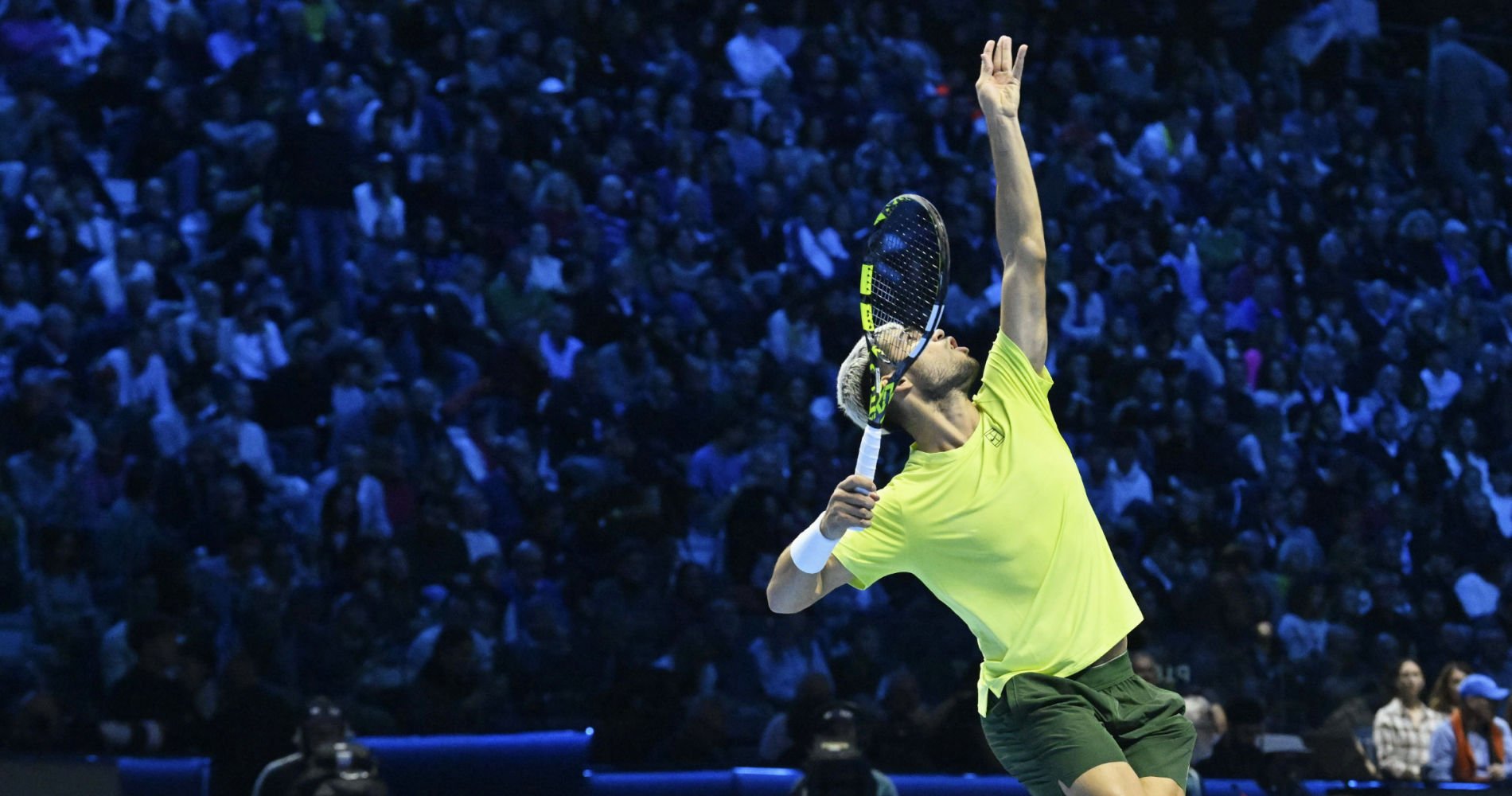
Renowned coach Patrick Mouratoglou highlighted this specific technical change on social media, noting that Alcaraz now drops his hand and allows the racquet head to fall at the very beginning of the motion. “The goal is to create more whip effect, and I think it makes a lot of sense to do it,” Mouratoglou analyzed. “Not all players do it. I mean, a lot of good servers don’t do that; they just have the whip effect at the end.”
Perhaps the most fascinating aspect of this technical tweak, confirmed by Alcaraz, is that it was largely self-initiated. Alcaraz revealed that his team originally didn’t want him to make a change, but he felt it was necessary for his comfort. “My team or my coach can tell you whatever, but if you don’t feel comfortable, you have to do something else,” Alcaraz said.
That is the true footprint of a champion, Mouratoglou noted. “Most of the top players are scared to make changes. They’re always scared to lose something… but the champions, they want to progress all the time.” Mouratoglou finds this autonomous adjustment particularly impressive, noting that Alcaraz’s game is “constantly technically adapting and moving. It’s not static; it’s always in movement.” This ability to “keep it simple” and find a “smooth, peaceful rhythm” without outside instruction signals a player who has reached a rare level of self-mastery.
The Final Piece of the Puzzle
As Alcaraz prepares for his quarterfinal clash against the 6th seed Alex de Minaur, his serve has officially transitioned from a “point-starter” into a primary weapon. In the final set against Paul, he won 86% of his first-serve points and faced zero break points – a level of security that allows him to take even more risks with his world-class forehand.
For the world No. 1, the serve is the only shot he has felt the need to “constantly tinker” with over the past year. “No other shot I’ve been changing anything or putting so much attention on,” he admitted. If the “sleeper” serve continues to find the lines in Melbourne, the youngest man to ever chase a career Grand Slam may have just found the final piece of the puzzle. It is the most obvious one: the serve remains the most important shot in modern tennis.