Rolex Monte-Carlo Masters: Alcaraz also needed three sets to reach the last eight
Carlos Alcaraz defeated Tomas Martin Etcheverry 6-1, 4-6, 6-3 in the third round of the 2026 Rolex Monte-Carlo Masters to reach the quarterfinals.
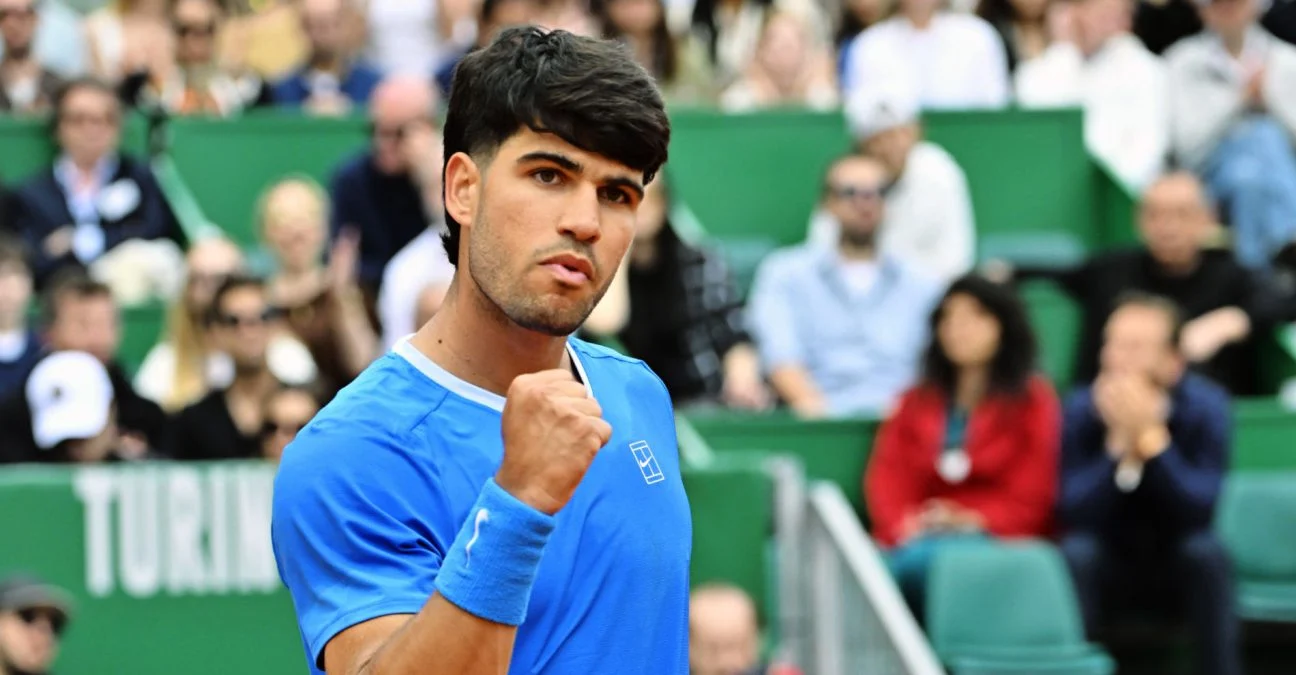 Carlos Alcaraz, Monte-Carlo 2026 | © Chryslène Caillaud, 2026

For a few games on Thursday afternoon, it looked like another routine Monte-Carlo day for the top two seeds. Carlos Alcaraz took the opening set from Tomas Martin Etcheverry in 20 minutes. A few hours earlier, Jannik Sinner had won his against Tomas Machac just as swiftly. Then both matches turned, and the day became something more interesting.
Alcaraz, the top seed and defending champion, eventually defeated Etcheverry 6-1, 4-6, 6-3 to reach the last eight of the Rolex Monte-Carlo Masters. Sinner had done the same against Machac. On the same afternoon, the top two players in the world each dropped a set having won the first 6-1. It was the first time either had been extended to three sets at this tournament.
For Alcaraz, the numbers told a story of uneven clay form. He committed 47 unforced errors, won only 63 per cent of points on serve and had his serve broken twice. The contrast with his opening match against Sebastian Baez – when he barely put a foot wrong – was sharp.
“I don’t have a feel for the ball”
Etcheverry did exactly what a player of his type is built to do on clay: he slowed the match, made it physical, and waited for Alcaraz to tighten. The Argentine came into Monte-Carlo with a 10-1 clay record in 2026, having won his first ATP title at the Rio Open in February after playing nearly seven hours on a single rain-disrupted Sunday. He had also beaten Grigor Dimitrov and Terence Atmane in back-to-back three-set matches to reach this stage. The attrition game is his natural language.
The moment that captured the match best came from the courtside microphones. At a difficult passage in the second set, Alcaraz turned to coach Samuel López: “I don’t have a feel for the ball, Samu.” The reply was calm and precise: “You have to hurt the ball, not the court. You’re not in a hurry.” Alcaraz found his way back in the third — breaking twice, reducing the errors, recovering the variety that defines him at his best on clay.
“I know Jannik, and we can all see that he always comes back stronger when he loses matches,” Alcaraz had said after his opening win on Tuesday, speaking about the No. 1 race. That rivalry now shapes every match he plays in the draw. A quarterfinal against Alexander Bublik, the No. 8 seed, awaits. If he gets through that, a potential semifinal against Lorenzo Musetti and a final against Sinner would follow — the same clay-court collision they staged in Rome and Paris last year, both of which Alcaraz won.
Bublik next
Bublik is not a straightforward opponent. He reaches this stage having beaten Gaël Monfils 6-4, 6-4 and won back-to-back clay titles last year in Gstaad and Kitzbühel. He has remade himself as a clay-court threat, a transformation that began, in part, from a conversation in this very tournament a decade ago — when a young Monfils told him this, not grass, was his surface.
Alcaraz, ranked No. 1, plans to play every clay tournament before Roland-Garros — Monte-Carlo, Barcelona, Madrid, Rome. “It’s very demanding physically and mentally,” he acknowledged before the tournament began. Thursday was a reminder that clay demands something even the world No. 1 does not always have in reserve.