US Open 2026 prize money: How much does the winner get?
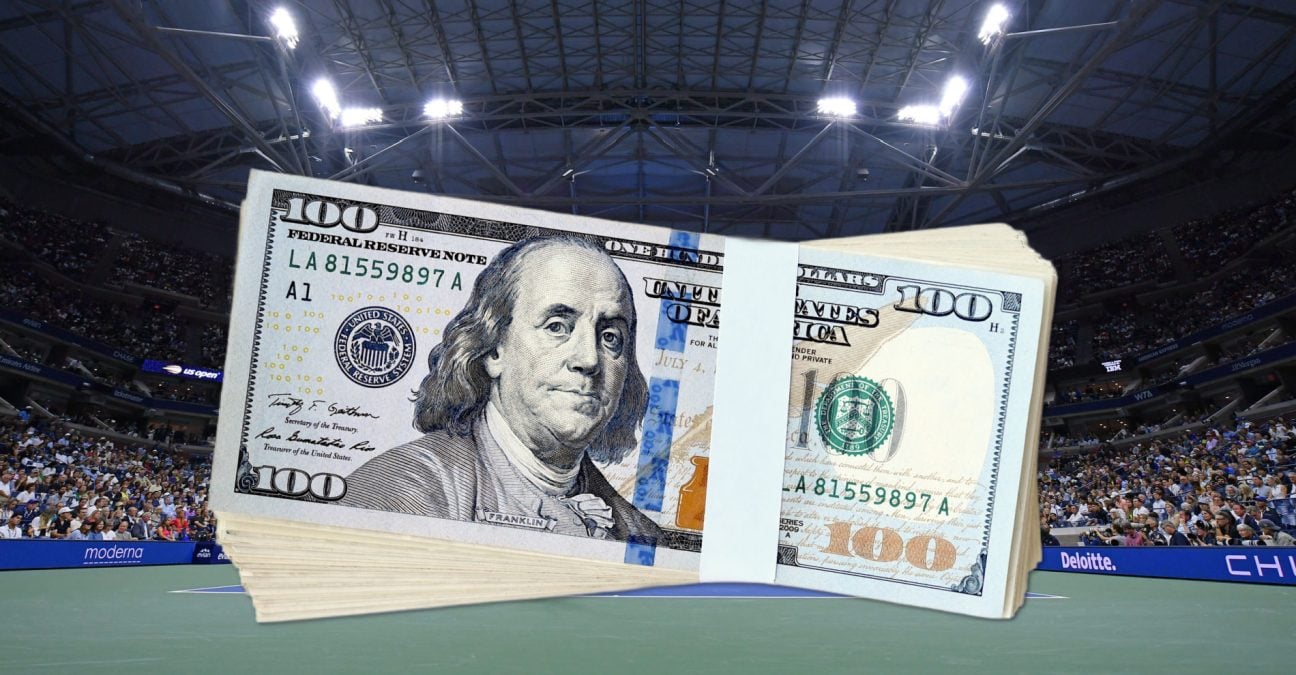
The US Open is set to break records again in 2026, with a projected total prize purse exceeding $95 million, making it the richest Grand Slam in tennis history. Both men’s and women’s singles champions are expected to take home a staggering $5 million, maintaining equal prize money across all draws. Dive into the full breakdown.
 US Open 2026, prize money

The US Open remains the richest Grand Slam in tennis. After a record-breaking $90 million total purse in 2025, the 2026 edition reaches $95 million – comfortably the largest prize pool in the history of tennis. The men’s and women’s singles champions will each take home $5 million, with equal prize money across both draws.
The tournament runs from August 23 to September 13 at the USTA Billie Jean King National Tennis Center in Flushing Meadows, New York, with the women’s final on Saturday September 12 and the men’s final on Sunday September 13.
Singles prize money: round by round
The men’s and women’s draws pay identical amounts at every stage. Even a first-round exit guarantees $110,000 — more than many ATP 250 tournament winners receive
Round Prize money
- Winner $5,000,000
- Runner-up $2,500,000
- Semi-finalist $1,260,000
- Quarter-finalist $660,000
- Round of 16 $400,000
- Round of 32 $237,000
- Round of 64 $154,000
- Round of 128 $110,000
The total singles prize pool across both men’s and women’s draws is approximately $63.2 million, roughly two-thirds of the entire tournament purse.
Doubles prize money
The men’s and women’s doubles champions each receive $1 million per team, with equal pay across both draws.
Round Prize money (per team)
- Winners $1,000,000
- Runners-up $500,000
- Semi-finalists $250,000
- Quarter-finalists $125,000
- Third round $75,000
- Second round $45,000
- First round $30,000
- Mixed doubles prize money
The Mixed Doubles Championship has been transformed into a marquee event during Fan Week, with a $1 million winner’s prize per team, by far the largest mixed doubles purse in tennis. This represents a dramatic increase from 2024, when the winning team received $163,000.
Round Prize money (per team)
- Winners $1,000,000
- Runners-up $400,000
- Semi-finalists $200,000
- Quarter-finalists $100,000
- Round of 16 $20,000
The 16-team mixed doubles main draw is played during Fan Week (August 25–26), with the semi-finals and final under the lights on Arthur Ashe Stadium.
How does the US Open compare to other Grand Slams?
The US Open pays significantly more than any other Grand Slam, both in total prize money and in singles champion earnings. Here is how the four majors compare in 2026 (approximate USD conversions in parentheses):
Tournament Total purse Singles winner First-round loser
2026 Grand Slam prize money comparison (USD)
Runner-up
First-round loser
Approximate mid-2026 exchange rates: £1 ≈ $1.30, €1 ≈ $1.10, A$1 ≈ $0.67. Equal prize money for men’s and women’s draws at all four Grand Slams.
The gap is striking: the US Open singles champion earns nearly 80% more than the Australian Open winner and over 60% more than the Roland-Garros champion in dollar terms. Only Wimbledon’s winner prize comes within range, at roughly $4.7 million equivalent.
All four Grand Slams increased their prize money for 2026. Wimbledon made the largest percentage jump (+20%), same as the US Open, while the Australian Open increased its total pool by 16% and Roland-Garros by roughly 10%.



US Open Prize money history
The US Open’s prize money has grown rapidly over the past decade, more than doubling since 2015:
Year Total prize money
- 2026 ~$95,000,000
- 2025 $90,000,000
- 2024 $78,000,000
- 2023 $75,000,000
- 2022 $60,100,000
- 2021 $57,442,000
- 2020 $53,452,000
- 2019 $57,268,700
- 2018 $53,000,000
- 2017 $50,400,000
- 2016 $46,300,000
- 2015 $42,300,000
The 2025 jump from $78 million to $90 million – a 15% increase – was the largest single-year rise in tournament history, coinciding with the first year of ESPN’s landmark 12-year, $2.04 billion television deal. The 2026 increase to an estimated $95 million continues that upward trajectory.