Rybakina out of Roland-Garros to Starodubtseva, the second seed beaten by 71 unforced errors and the conditions she could not control
Elena Rybakina (No 2), the Australian Open champion, is out of Roland-Garros, beaten 3-6, 6-1, 7-6(4) by Ukraine’s Yuliia Starodubtseva (world No. 55) on Court Suzanne-Lenglen. “Just pity, because I was practicing well before French Open”, she said.
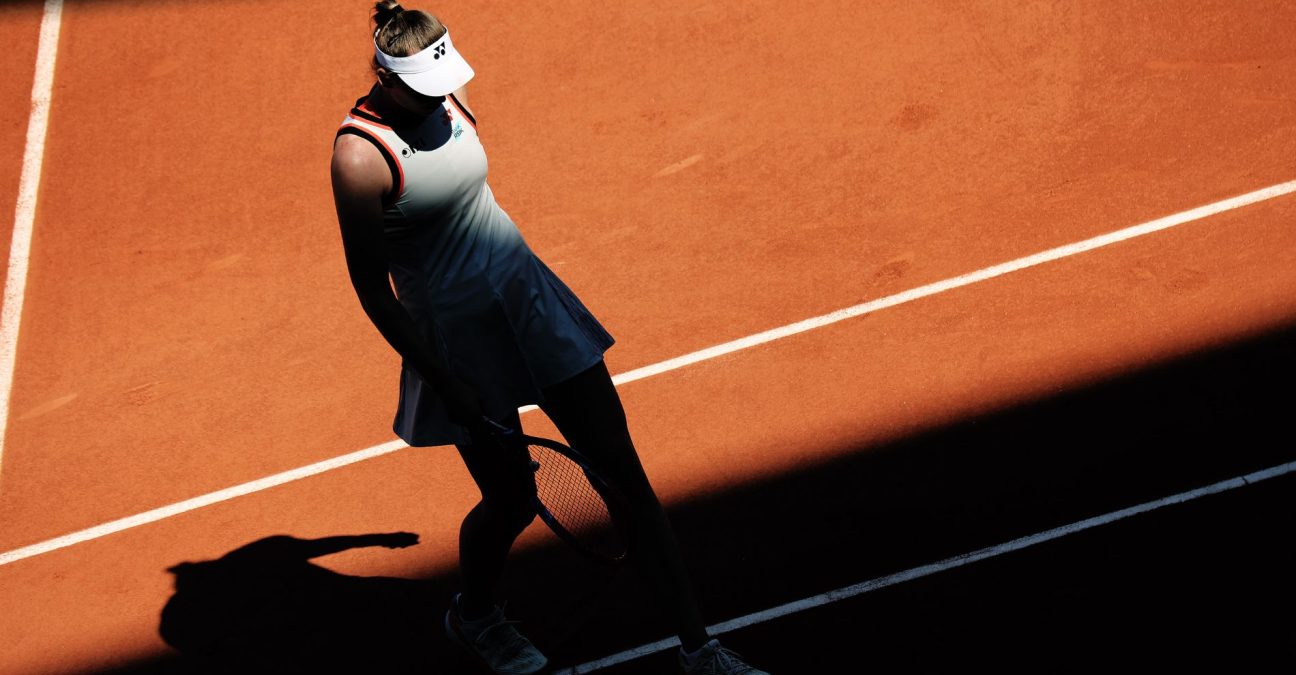 Elena Rybakina – Roland-Garros 2026 © Gepa / Psnewz
Elena Rybakina, the world No. 2 and 2026 Australian Open champion, was knocked out of Roland-Garros in the second round on Wednesday afternoon, beaten 3-6, 6-1, 7-6(4) by Ukraine’s Yuliia Starodubtseva on a sun-baked Court Suzanne-Lenglen – the biggest upset of the tournament so far and the highest-seeded player out of the women’s draw.
Rybakina had won the first set 6-3 in the kind of efficient, ball-striking opening that has been the pattern of the most productive year of her career: 30 wins for 7 losses before Paris, the Australian Open title in January, the Stuttgart trophy on her clay debut, and a place in the world’s top two she had carried into the tournament for the first time.
The second set was the moment everything turned. Starodubtseva, the world No. 55, raised her own level and Rybakina lost the thread of the contest. She made twice as many unforced errors as she had in the opening set, hit half as many winners, and was 5-0 down before she could find a game. The second set ran 32 minutes. She left the court between sets to gather herself.
She returned and slipped further behind. Starodubtseva broke twice in the third to lead 3-0, and the upset began to look inevitable. Rybakina found one more push from there. She broke back to 1-3, broke again to level at 4-4, and stretched her lead to 5-4 – a swing that owed as much to Starodubtseva tightening as to her own returning level.
The Ukrainian held to force the deciding tie-break, which under the unified Slam rules now in place reaches 10 points rather than seven. Starodubtseva took it 10-4. Three Rybakina forehand errors inside a five-point stretch handed her a 6-2 lead in the breaker; she did not give the lead back. The match ran two hours and 28 minutes. Rybakina finished with 71 unforced errors to Starodubtseva’s 36, against 23 winners to 13. She was direct afterwards about the source of the problem.
Actually today it was very bad performance, too many unforced errors, and, yeah, didn’t feel the greatest.
“Just pity, because I think I was practicing well before French Open, and I was feeling also good on the practices and thought that I can raise the level,” Rybakina said. “But actually today it was very bad performance, too many unforced errors, and, yeah, didn’t feel the greatest.”
The conditions on Suzanne-Lenglen – 33 degrees in the shade, blazing direct sun, the court playing fast in the heat – sat at the centre of her diagnosis without becoming her excuse. “Definitely when it’s so hot, the ball is flying. It’s very difficult to control. Especially me being always aggressive, trying to play fast and step in, if you don’t give enough spin or if your hands are not as fast, the ball is flying everywhere.”
Her box, she said, were telling her in real time what the surface required. “They were just trying to tell me to raise my energy, try to push more with the legs since the ball is flying so much. Even on the simple balls, which you feel like coming not so fast, the ball bounces so high that you need to really force the wrist. You need to play with fast hands.” The court itself, in patches, was working against her. “It was very slippery. In some moments I was just putting my legs, but it was everything out of rhythm.”
She knew what would have given her a chance against it. “In such conditions you really need to be super patient, try to spin the ball as much as you can, and, yeah, definitely come to the net. For me it was, as I said, too many mistakes that I can’t even talk about coming to the net and all these things.” The shorter version came at the end: “Today it was not enough from my side. So even when I was not really attacking the ball, I was trying to keep it in play. I had too many mistakes.”
For Starodubtseva, the 26-year-old Ukrainian who came through American college tennis at Old Dominion University, the win is the first of her career against a top-10 opponent – she had lost her first six attempts, most recently a 6-2, 6-2 defeat to Jessica Pegula in the Charleston final last month. She is now into the third round at Roland-Garros for the second time in two years, equalling her career-best at a Grand Slam, with a place in the second week to play for. She will face the winner of 26th seed Hailey Baptiste against Xinyu Wang.
For Rybakina, who has now never been past the quarter-finals at this tournament in eight appearances, the focus shifts to a grass-court season that begins immediately, on the surface where she lifted her first Grand Slam trophy in 2022.
Down a double break at 3-0 in the decider, Rybakina dug deep to fight her way back and force a final-set super tie-break, only to completely fall apart, losing it 10-4. The Kazakh will now shift her focus to Wimbledon, a Grand Slam she famously won back in 2022.

People in this post

More tennis news
Sinner ends 2026 season due to knee inflammation, misses ATP Finals


October 6, 1986: The day Pat Cash clashed with Brad Gilbert en route to Davis Cup glory


Djokovic into Beijing final vs. De Minaur after Medvedev is disqualified!

Alcaraz recovers from a set down against Munar to set up Tokyo final with Lehecka
October 5, 1918: The day French aviator Roland Garros was killed during World War I