Well, it didn’t escalate quickly – On Roland-Garros media day, players were united, each in their own way
Twenty-three players spoke on Friday, there was no boycott, no real challenge to the FFT’s refusal to move on this year’s prize money, and, underneath it, the sense that this was not the moment to act, only to make sure a conversation would open.
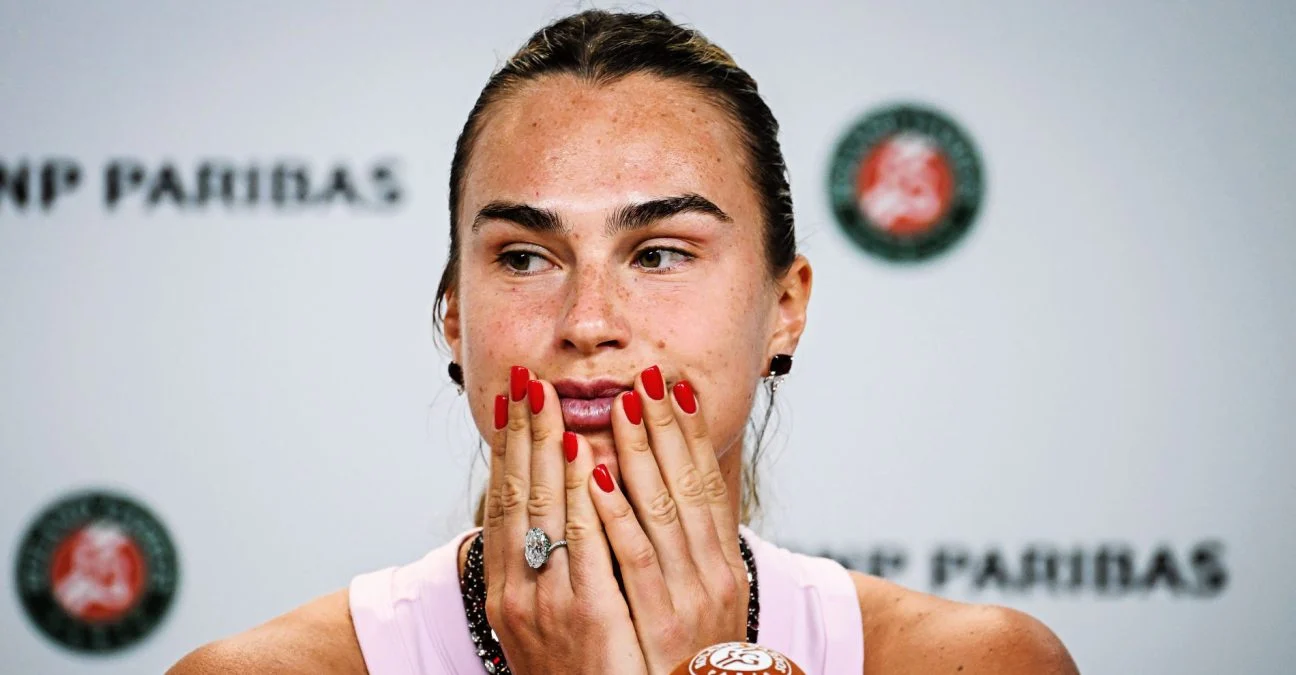 Aryna Sabalenka, Roland-Garros 2026 | © Baptiste Autissier / PsNewz

There was no boycott. There was no walkout. The 2026 Roland-Garros prize money — €61.7m, up 9.5% on last year, far from the players expectations — was acknowledged as fixed for this edition by every voice that addressed it. The “only15-minute” media commitment that the leading players agreed to observe on Friday came and went, mostly observed, occasionally stretched, often assumed with shyness if not outright apology, and never escalated.
By late afternoon, the day’s structural finding was clear: the players who came to Paris to put pressure on the four Grand Slams had also, in the course of speaking, admitted between the lines how far they still are from being able to apply any.
Independant contractors
Felix Auger-Aliassime, the No. 4 seed, gave the cleanest articulation of why. “We’re not unionized in an official way because we’re independent contractors,” he said. “We’re not employees of any company, so we cannot officially unionize. But we are together. We’re together, I would say, unofficially.” And, as it turned out, elastically. Auger-Aliassime himself had pushed back against the players complaining about the calendar in Turin last November.

What the players say they want is a seat at the table. Ben Shelton, the U.S. No. 1, was the most precise on the content of the letter the leading players sent to the Slams: “A lot of the talk is about the prize money, which is part of our letter, but it’s not the only piece of it. We want a seat at the table. We want to be able to be heard, respected. There’s other issues, whether it’s pension, benefits that solely land on the ATP, or — wow, I’m blanking right now — bonus pool.”
Who decides if they start now three Grand Slams out of four earlier ? We start Sunday, but we don’t know if they want to start Saturday or Friday
Jannik Sinner, the world No. 1, added a fourth item that no one had put on the record before: Slam scheduling. “Who decides if they start now three Grand Slams out of four earlier ? We start Sunday, but we don’t know if they want to start Saturday or Friday”. So we would like to have also a small conversation into that.” Auger-Aliassime added a fifth: format. “Maybe tournaments decide they want to start on Sunday or they want to play a fifth-set super tiebreak.”
What the players also say more clearly is that this is not for them. The framing was identical across both World No. 1s and the most senior voices in the men’s game. “It’s not about me,” said Aryna Sabalenka, whose $15m in 2025 prize money was the highest single-season total in WTA history, and whose $49m career total trails only Serena Williams on the all-time list. “It’s about the players who are lower in the ranking, who are suffering,” she continued. “It’s not easy to live in this tennis world with that percentage that we are earning. As the World No. 1, I have to stand up and to fight for those players, for lower-level players, for players who are coming back after injuries, the upcoming generation.


Iga Swiatek, the No. 3 seed and four-time Roland-Garros champion: “We will do more when the tournament will do more for us. Not only us, the top players, because obviously we are the ones that have the most contact with you guys, but for also the lower-ranked players and the whole structure.”
Shelton, on the underlying economics: “Sometimes for a player who is 150 in the world or 200 in the world, this is the one tournament where they get a big check. At a challenger I think maybe if you win the tournament, you get, like, 7 grand [roughly $7,000]. Adding prize money in a tournament like this (Grand Slam) four times a year (89.000 dollars at Roland-Garros) can really help keep their year in the green instead of the red.”
When you send the mail in, no one responds to official mail for months. It cannot be only one way that you use players, and that’s it.
Andrey Rublev, on the ATP Player Council, gave the longest defence of the action: years of unanswered emails, communication that doesn’t happen, a basic asymmetry. “When you send the mail in, no one responds to official mail for months. It cannot be only one way that you use players, and that’s it.”
Coco Gauff, who confirmed the timeline of how the protest came together — discussions started a year ago, intensified in Rome, formalised in Paris this week — was candid about the limits of what Friday could achieve. “I think for me it’s not necessarily going to make a big difference to the slams for this tournament,” she said. “But I think it shows a lot of us are all on the same page and have kind of a collective action other than just having conversations, and I think this is the first real point of action we have done.”
Not the B. word
Gauff was one of the two that used the word boycott in Rome. But she could feel lonely in Chatrier’s underground. The word boycott itself was held at arm’s length all day. Taylor Fritz, asked directly whether he could imagine players going further, refused even to use it: “I don’t know if I want to start throwing around the ‘B’ word. It’s a really big deal, and I don’t think we as players should really make big threats like that unless we’re fully ready to do it. I want to really mean it if I’m going to say it.”
Daniil Medvedev made the same gesture in different language: “We don’t want to hurt ourselves. We don’t want to hurt anyone. We just want a discussion with the slams.” And Coco Gauff, asked whether players might be ready to skip press altogether and take the fine, marked the line precisely: “It was a fine line of what we can do but also not punish you guys, because you guys have nothing to do with this.”
“Let’s see also how other Grand Slams are going to react after here, and then we’re gonna decide.”
The Australian Open and Wimbledon, Sinner suggested, are now on the clock. “Let’s see also how other Grand Slams are going to react after here, and then we’re gonna decide.”
The Fédération Française de Tennis, organising Roland-Garros, has not moved. Amélie Mauresmo, who closed her own pre-tournament press conference to draw questions after less than four minutes earlier this week, has stated the federation’s position plainly: the 2026 prize money is set, the non-profit model is the model, the players’ messages have been heard but the purse will not be reopened.

The leading players have absorbed it. None of them said on Friday that they expected this tournament’s pot to change. What they said, in different ways, is that they hope the action accumulates — that doing it here, knowing it won’t move the FFT, builds a precedent the players can carry to Wimbledon and the US Open. “We waited one year to have a small response,” Sinner said. “Having the best ten players, and it’s not nice.”
Novak Djokovic was not part of the action. The 24-time Grand Slam champion, who cut ties with the PTPA in January, declined to comment on the planning or the decision-making of a group he had not been part of, and then made the most sophisticated version of the players’ own argument anyone made all day.
The same lower-ranks framing: “I have always been on the players’ side and tried to advocate for players’ rights and better future for players, but not only top players, players across all rankings, across all fields, particularly the Tier 1 professional tennis.”
Vacherot’s different tone
And then the critique nobody else risked. “We are very fragmented. It’s already complex enough as a sport, how the structure is set and how we are regulated. So the further fragmentation is really hurting me personally. Let’s learn also from golf. I think golf is a good example of professional individual global sport that has been through and is still going through very challenging times in terms of the governance and splitting tours and players. Let’s try to be a bit more united and have a unifying voice into finding better structure and better future for our sport.”
It was a defence of the goal that was also an indictment of the institutional form — RedEye, the player committee the protest runs through — that the goal is currently being pursued through.
And then there was the player the protest claims to be fighting for. Valentin Vacherot, the 26-year-old Monégasque who spent three years on the Challenger circuit ranked between 200 and 300, who won Shanghai in October, and who arrived in Paris this week seeded in the high 30s, was asked whether prize money distribution was important to him.
I’ve been in challengers for three years and I’m on an ATP tournament, I have no reason to complain.
“I’m probably not in the best position to answer because I’ve been on the major tournaments for six or seven months,” he began. “For three or four years I was ranked 200, 300, and in my opinion, those are the players who should be making more. But the prize money have increased so dramatically over the past ten years. Compared to what they were twenty years ago, they’ve actually skyrocketed. So I think we are living through great times for tennis with great prize money.”
The line that does the work, four sentences later: “When I’ve been in challengers for three years and I’m on an ATP tournament, I have no reason to complain.”
Boisson, Boulter : there is nothing here
The top of the field is uniformly engaged. Nine signatories spoke on Friday, plus Djokovic in substance. Below the top 30, engagement collapses. Loïs Boisson, last year’s semi-finalist and one of the home faces of this tournament, declined to take a position: “I don’t really know the numbers, what’s true, what’s false.” Elsa Jacquemot: “I’ve heard about it, but I’d rather not take any position about this.” Katie Boulter, whose partner Alex de Minaur is a signatory: “I do live a little bit, like, under a brick. I think I try and keep myself away from everything going on.”
Mirra Andreeva and Elena Rybakina both expressed support without confirming they were limiting their own pressers. And Corentin Moutet, the most direct: “I’m not part of any movement. It is an individual sport. If there was actually a movement, we would have known of it earlier.” Yet fourteen months ago, he was a named plaintiff in the PTPA class action against the ATP, WTA, ITF and ITIA — making him, like Djokovic, a player aligned with the previous wave of collective action who has chosen to sit out the current one.
A few minutes later, the order of play for Sunday was set. The players will take the court – and, as soon as they cash their loser’s cheque, turn their attention to what Wimbledon decides to put on the table.