How India became one of tennis’s fastest-growing audiences

Record Wimbledon audiences, Hindi commentary and a record US Open on Indian television have made India a key growth market for tennis. On court, Rohan Bopanna, Sumit Nagal and a Davis Cup win in Bengaluru carry a sport that still lacks support at home.
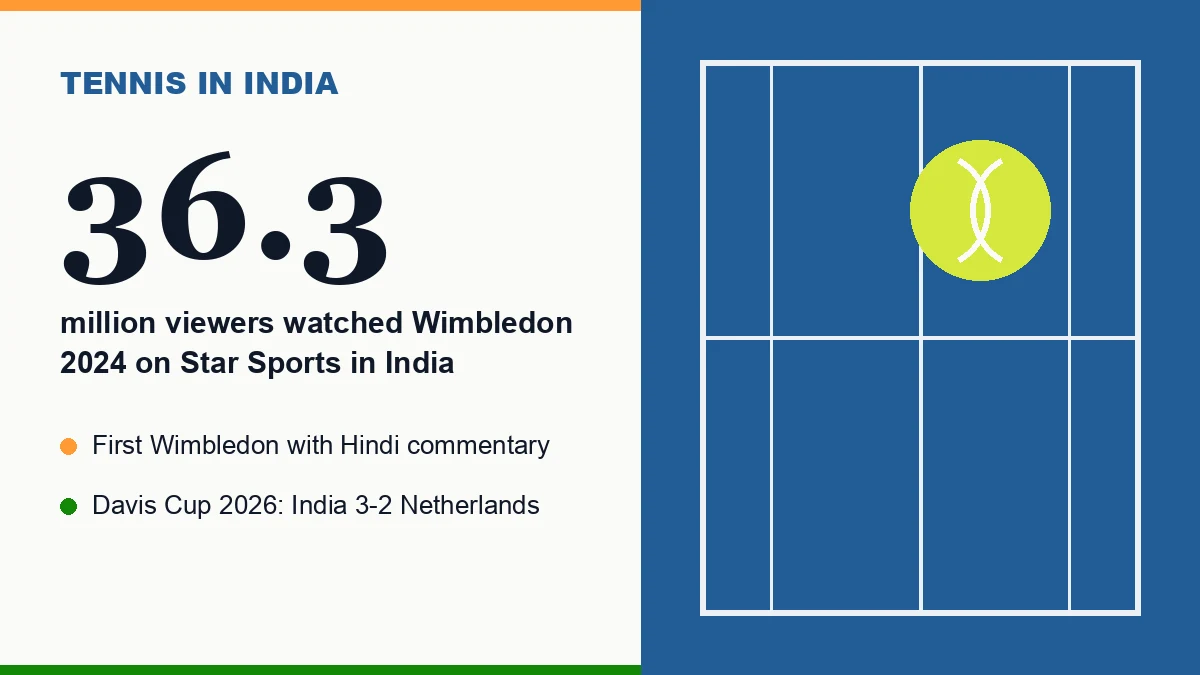 Tennis in India: a fast-growing audience
In July 2024 the All England Lawn Tennis Club announced a deal with Star Sports Network to show, for the first time, Wimbledon matches with Hindi commentary. The viewership of Wimbledon in India had risen 96 per cent in 2023 compared with 2022, while entries from Indian fans into the 2024 Public Ballot were up 74 per cent on the year before. Acknowledging the rising popularity of Wimbledon in India, the club singled out the country as a key growth market. Indian fans can also follow the tour on sports sites such as telecomasia.net, which runs a tennis news section.
Hindi commentary, record audiences and streaming
Former Wimbledon champion Leander Paes said it was heartening to see the Championships growing in India, that Hindi commentary would get more people to watch, and that with several young players taking up the sport he saw this as only the beginning. Indian tennis player Ankita Raina recalled waiting eagerly as a child for Wimbledon to start. The All England Club’s commercial and marketing director, Usama Al-Qassab, said interest in tennis had grown tremendously in recent years, shown by viewing figures, ballot entries and the club’s social media numbers in India.
According to BARC, Star Sports’ coverage of Wimbledon 2024 went on to become the most watched grand slam ever in India. The Hindi coverage added notably to growth across Hindi-speaking regions like Delhi, Maharashtra, Gujarat, Uttar Pradesh and Bihar.
The men’s singles final between Carlos Alcaraz and Novak Djokovic got the top rating ever in India for a men’s grand slam final, and the women’s final between Barbora Krejcikova and Jasmine Paolini became the highest-rated women’s grand slam final in India. Highlights and shows in Hindi, Tamil and Kannada reached an extra 14 million viewers who sampled the event for the first time.
The 2025 edition, now with JioStar, saw 77 per cent growth in viewing on its JioHotstar streaming service, while the newly acquired US Open set a benchmark of 388 million minutes of viewing on linear TV, the highest ever for that tournament in India. JioStar holds exclusive Indian rights to the US Open until 2030.
India’s grand slam audience by the numbers (broadcaster and Wimbledon figures)
| Year | Measure | Figure |
|---|---|---|
| 2023 | Rise in Wimbledon viewing in India vs 2022 | +96% |
| 2024 | Wimbledon viewers on Star Sports | 36.3 million (+176% vs 2023) |
| 2024 | Total Wimbledon watch time | 930 million minutes (+40% vs 2023) |
| 2024 | Unique viewers of Wimbledon’s Hindi coverage | 18.4 million |
| 2025 | Growth in Wimbledon viewing on JioHotstar | +77% |
| 2025 | US Open watch time on linear TV | 388 million minutes (tournament record) |
Tennis in India: what still holds it back
For 21 years this century, India was one of the places where the tennis season opened. The ATP 250 event it hosted in Pune, and before that in Chennai and New Delhi, was the largest event in the country and brought Rafael Nadal, Stan Wawrinka, Carlos Moya and Daniil Medvedev to Indian tennis courts. In 2024 it moved for good to Hong Kong. Tennis enthusiasts still remember the elegance of Vijay Amritraj, the booming Bhupathi serve and Paes at the net.
Ever since Ramanathan Krishnan’s era in the 1950s, Indian tennis players have mostly had to fund their own careers, living chiefly off prize money with little or no backing from the federation. Former India No 1 Somdev Devvarman has said that lack of support is one of many reasons for a trust deficit between players and the All India Tennis Association (AITA). At the start of 2024, India had seven men’s doubles players inside the top 100 of the rankings but no singles player there, the Davis Cup team had dropped to the World Group II level in 2023 for the first time, and nobody clear had yet taken up the path Sania Mirza paved in the women’s game.
Bopanna and Nagal
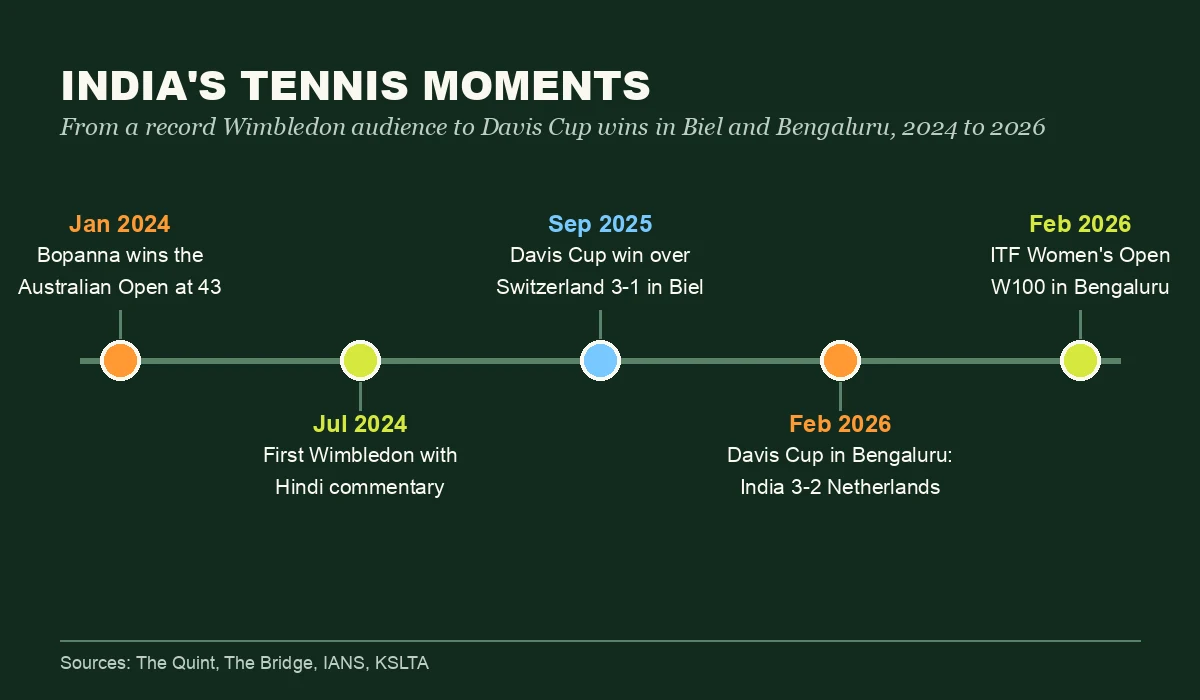
At 43 years, 10 months and 23 days, Rohan Bopanna won the 2024 Australian Open men’s doubles with Matthew Ebden of Australia on Rod Laver Arena, the oldest man to win a grand slam title, shortly after becoming the oldest player to hold the world No 1 ranking in doubles. He is the fourth Indian with a grand slam title, after Paes, Mahesh Bhupathi and Sania Mirza. After match point the pair bumped chests, a celebration linked with Paes and Bhupathi, before sinking to the ground. His first major had come in 2017, the French Open mixed doubles title with Canada’s Gabriela Dabrowski, so he now has grand slams in both men’s doubles and mixed doubles.
Sumit Nagal always wanted to play cricket as a kid, he told The Bridge, but his dad was not a big fan of team sports, and one of his father’s friends suggested tennis. Nagal picked up a racquet at seven and a half and, in his words, never looked back. A turning point came when he was picked for Mahesh Bhupathi’s tennis academy under the Apollo Tyres Mission 2008 programme. He credits the Tennis Premier League with introducing tennis to a broader audience. His milestones so far:
- 2015: Wimbledon boys’ doubles title with Vietnam’s Ly Hoang Nam
- 2020: first Indian since 2013 to win a main-draw singles match at a grand slam
- 2021: first Indian in 25 years to make the second round of an Olympic singles event, in Tokyo
Davis Cup in Bengaluru
By then the team had climbed back. In September 2025 in Biel, India beat Switzerland 3-1 in World Group I, their first win over a European country in Europe since 1993, when a side with Paes and Ramesh Krishnan beat France, and Nagal sealed it by beating Henry Bernet 6-1, 6-3 in the reverse singles. In February 2026, hosts India faced an uphill battle against a higher-ranked Netherlands at Bengaluru’s SM Krishna Tennis Stadium in the Davis Cup qualifiers, with the Dutch ranked sixth in the world and India 33rd. Home advantage exists in any sport, Nagal said before the tie, recalling that at the Olympics he had five people cheering for him in front of 7,000 French supporters. Helped by Dhakshineswar Suresh’s 6-4, 7-6 win over Guy Den Ouden in the deciding fifth rubber, in which he fired 15 aces, India took the tie 3-2 and moved on to September’s second qualifying round. There, in Seoul, they lost 3-1 to South Korea, who went through to the Final 8 in Bologna, so India will start again in the first round of the 2027 qualifiers.
Back in February, about ten days after the Netherlands tie, during the ITF Women’s Open W100 in Bengaluru, Andrew Moss of the International Tennis Federation said India was a huge country with a huge tennis history and massive potential. He called the ITF World Tennis Tour, with nearly 1,200 tennis tournaments across 75 countries a year, the main pathway for players moving up from junior and entry-level events onto the professional circuit, and said the facilities at the stadium were fantastic. He also met officials of the Karnataka State Lawn Tennis Association to discuss bringing more ITF World Tennis Tour events to Bengaluru, creating additional opportunities for Indian athletes. Pointing to the Davis Cup tie, he said that in a team competition players represent their countries and do extraordinary things, and that the run of events in Bengaluru was starting to act as a real catalyst for interest in the game there.




People in this post


More tennis news
“She’s a diva”: Pegula caught on hot mic criticising Andreeva, WTA apologises


Race to Turin, daily: Fritz must beat Alcaraz to stay alive and knock Jodar out

November 6, 2005: The day Tomas Berdych won his first and only ATP Masters title


Ruud holds every service game against Struff and will seek revenge against Borges


Fritz keeps his Turin hopes alive, beats Fils in Paris to set up Alcaraz quarter-final