The defeat against Alcaraz that told Zverev he was right: how Melbourne launched his year
Ten months before facing Carlos Alcaraz in the ATP Finals final, Alexander Zverev lost to him in five sets and 5h27 in the Australian Open semi-finals. On the eve of their rematch in Turin, the world No. 1 explained why that defeat convinced him he was on the right track, as he had predicted that very night.

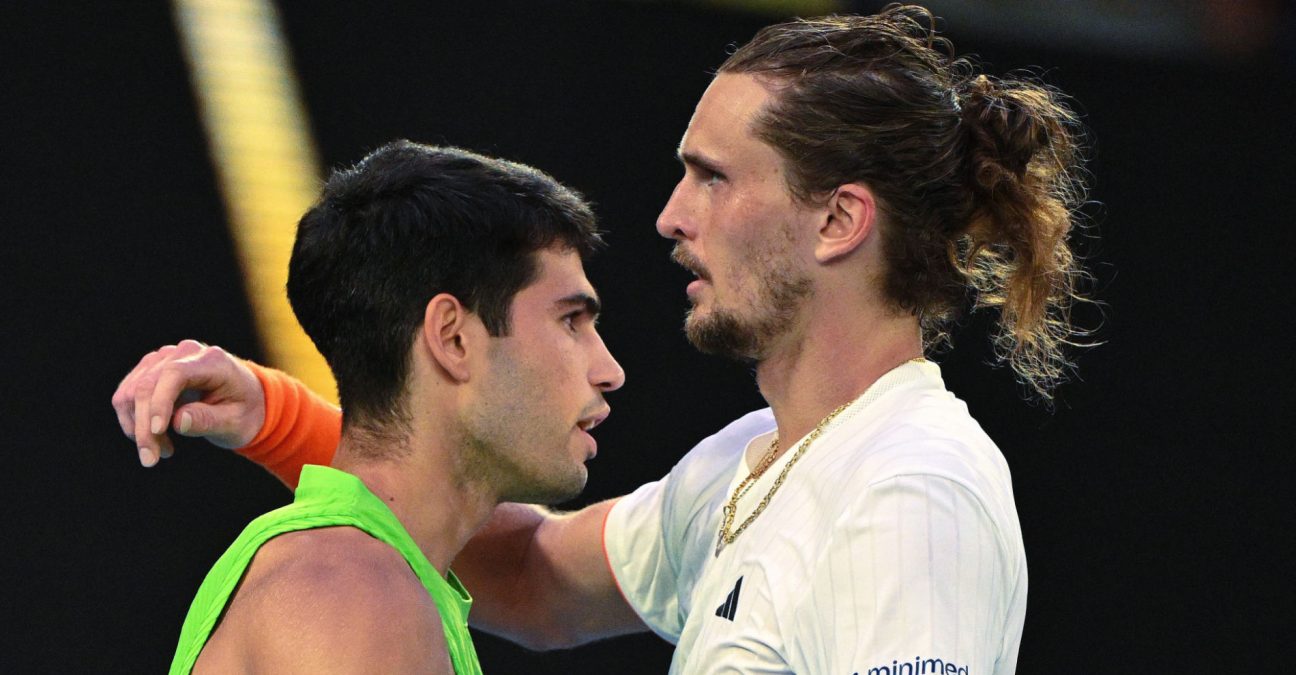 Carlos Alcaraz and Alexander Zverev, ATP Finals 2026 | © Imago / PsNewz
“I don’t think it changed my season. I think it gave me confidence in what I was trying to do this year.” On Saturday in Turin, on the eve of the ATP Finals final, Alexander Zverev went back to the match that set his year in motion: the Australian Open semi-final he lost 6-4, 7-6(5), 6-7(3), 6-7(4), 7-5 to Carlos Alcaraz, after 5 hours and 27 minutes, in January. On Sunday, he faces the Spaniard for the first time since.
“I talked about it a lot, I was trying to change my game, trying to play a different kind of tennis. And that match proved to me that it’s the right thing to do,” he said. “Even though I lost the match, I’ve said it so many times, I was quite happy. So I think that was the start of something good this year.”
What he said that night
Zverev had seen it coming. That night in Melbourne, exhausted after coming back from two sets down, he was already looking ahead. “This is the start of the year, so if I continue playing that way, if I continue training the way I train, if I continue working on the things that I’ve been working on in the off-season, I do believe it’s going to be a good year for me,” he said. “I think we both went to our absolute limits, so somewhat I’m also proud of myself.”
He went on to win Roland-Garros and the US Open, his first two Grand Slam titles, and became world No. 1 on November 2.
200 points to 194
The numbers backed him up. Alcaraz won only six more points than him, 200 to 194, both men converted 29% of their break points (4 of 14 for Alcaraz, 2 of 7 for Zverev), and the German hit 17 aces to 12. Above all, he won the long exchanges: 29 of the 44 points that lasted nine shots or more. Alcaraz made the difference in the short points, winning 129 of those that lasted four shots or fewer against 114, with 78 winners and 32 drop shots.
Zverev drew the lesson himself that night. “He was hitting a lot of winners from the first shot, so I wasn’t getting into the rallies. I should have probably been a bit more aggressive.” That became the project of his season. By Roland-Garros, the data showed it: the share of his points decided within the first four shots had risen from 58% to 69% in a year, and his rallies of nine shots or more had fallen from 16% to 9%.


The second set, and the legs in the fifth
He also left Melbourne with one regret. “The second set. That one, for me, I felt like I should have won. You know, especially serving for it, I didn’t play a good game serving for it,” he said. “Funny enough, I don’t have many regrets in the fifth set, because I was hanging on for dear life, to be honest. I was exhausted.”
In the decider, serving at 5-4, his body let him down. “Normally I can rely on my serve a bit more. My legs stopped pushing upward, so yeah, that’s the way it is.”
The match also left a controversy. Alcaraz, cramping in the third set, received a medical timeout, which Zverev said “normally you can’t take” for cramping. But he refused to make it the story: “I think this is one of the best battles there ever was in Australia. It doesn’t deserve to be the topic now.”
Sunday, the rematch indoors
Since Melbourne, Zverev has not beaten Alcaraz or Jannik Sinner. But he is 3-0 against the Spaniard indoors, and his last two wins over him came here in Turin, in 2023 and 2024. “I enjoy the challenge of playing the best in the world,” he said on Saturday. “I look forward to tomorrow.”