“Nothing is set in stone”: Gaudenzi defends two-week Masters before 2030 review
Speaking at the ATP Finals in Turin, the ATP Chairman tied the 12-day format to a compromise on profit sharing, main-draw spots for the top 100 and player health, and said he does not know how top players will treat Canada.

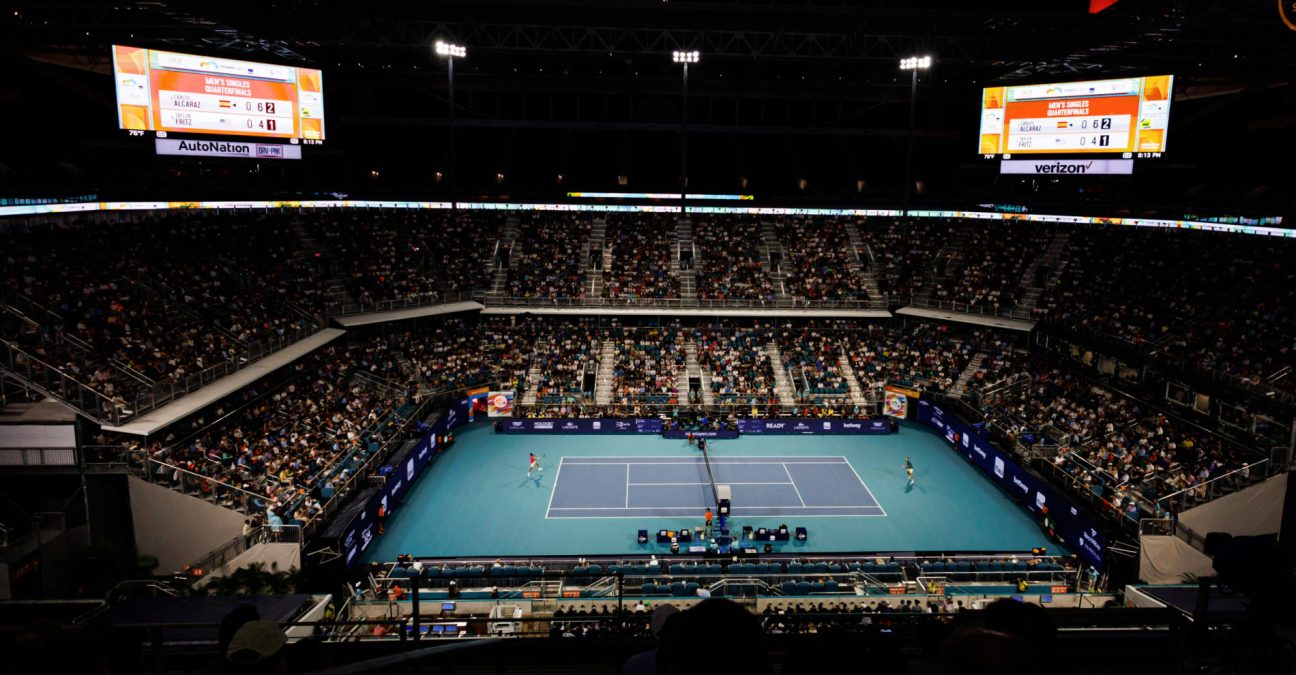 Miami Open Center Court, Hard Rock Stadium
ATP Chairman Andrea Gaudenzi defended the 12-day Masters 1000 format on Friday, saying a review period is set for 2030 and that “Nothing is set in stone.” He was speaking at a press conference at the ATP Finals in Turin, as the tour pushes ahead with its 2028 plan. Asked about players’ continuing complaints over the length of the events, he said: “I wasn’t naive when I proposed this plan.”
Gaudenzi said the format was negotiated over two and a half years and was part of the compromise that brought transparency and profit sharing. He recalled playing Indian Wells and Miami as two-week events for many years, without the financial reward players now receive.
The Italian leader added that when he came on board, Novak Djokovic was the first to ask for “more jobs to more players.” One-week, 56-draw Masters sometimes had a cutoff around 45, he explained, so a player ranked 50th missed the main draw.


He also made a health argument, recalling the back-to-back Rome-Hamburg and Rome-Madrid weeks, when an unseeded player had to play 12 matches in 14 days. Players would finish a night match at 10 p.m. and be back on court at 2 p.m., he said. Spreading the matches over more days leaves time for massage, recovery and medical treatment, he argued.
Gaudenzi also described a “dollar-per-day discussion,” with the ATP competing against exhibitions that also pay players. Higher Masters compensation, he said, should make players feel properly rewarded and let them skip events outside the ATP tour. After a conversation with the top 20 in Paris, he said, “they’re buying into the concept,” while stressing he did not want to speak on their behalf.
Players control half of the ATP board, but going back to shorter events would mean going back to the old economics, he warned.
The Canada question
Gaudenzi was also asked about the back-to-back Masters 1000 events in Canada and Cincinnati. In 2026, Montreal ran from August 2 to 13, three weeks after the Wimbledon final, and the main draw in Cincinnati started on August 13, the day Montreal ended. World No. 1 Jannik Sinner and Djokovic withdrew from Montreal, and Sinner, with a knee injury, and Carlos Alcaraz, with a wrist injury, missed both events.
After Roland-Garros and Wimbledon, the leading players want a break before the US Open. Sinner said after winning Wimbledon that “the most important thing for me is to switch off completely,” and Alcaraz said at the US Open that he would start missing tournaments, “because it’s impossible to play them all.”
Obviously squeezed because the time between Wimbledon and US Open is stretched
Gaudenzi acknowledged the problem. “Canada is obviously squeezed because the time between Wimbledon and US Open is stretched,” he said. “Definitely players need to take a break within the season, and if it’s a very hard stretch, French, Wimbledon, they need a bit of a rest in between that.” On whether top players will play Canada, he said “the answer is I don’t know,” since a player who reached the finals at Roland-Garros and Wimbledon will look at it differently from one who lost in the second round.
He noted that top players already enter about nine out of 10 Masters 1000 events, and that a player going deep at every Slam might play seven or eight. In what he called “my subjective opinion,” it also depends where players are from: Italians and Spaniards probably like Ibiza and Sardinia in summer, while North Americans take holidays elsewhere. He cautioned against jumping to conclusions, noting that part of what happened in the last couple of years was related to injuries.