Mauresmo defends night-session record as women’s near-absence is questioned again
Amélie Mauresmo once again defended Roland-Garros’ night-session scheduling, responding to questions about the near-total absence of women’s matches in the prime slot. She highlighted the overall daily balance and explained the factors influencing the single night match selection, including match length and audience preferences.
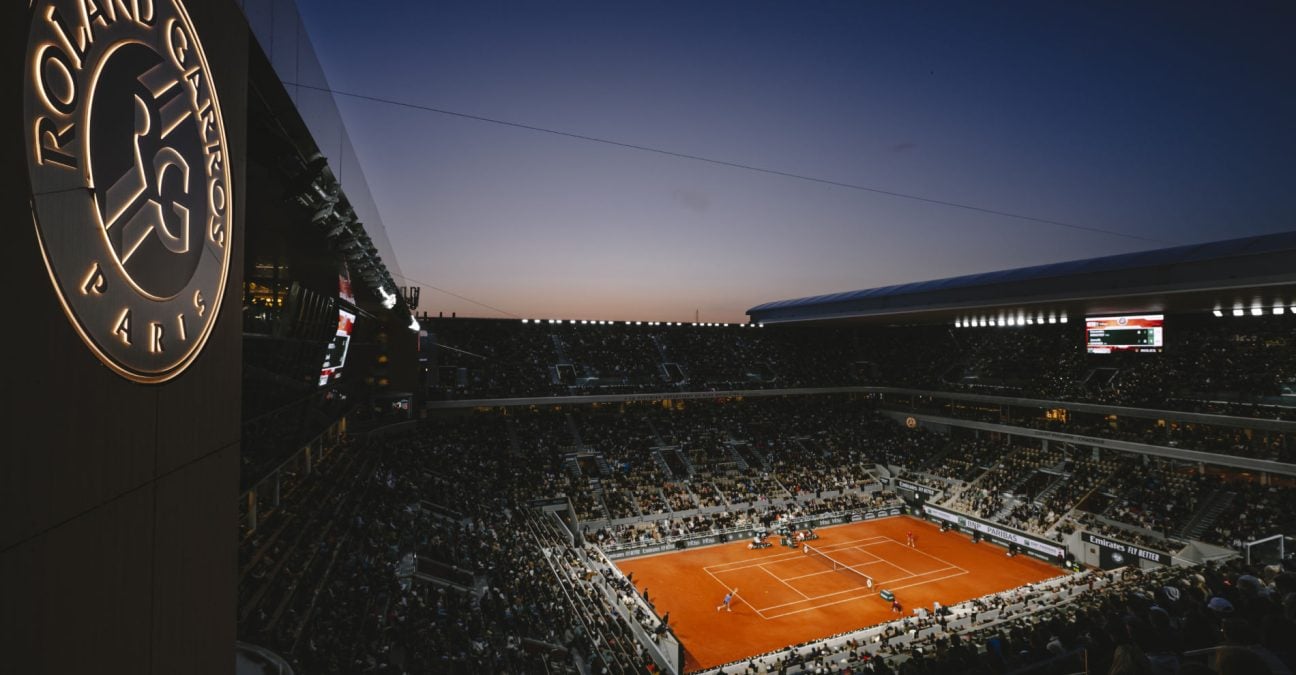 Roland-Garros, court Philippe-Chatrier, night session | © FFT
Amélie Mauresmo again defended Roland-Garros’ night-session selection on the tournament’s final day, after being challenged on the near-total absence of women from the slot over the past three and a half years.
The Sabalenka–Osaka match on 1 June, which Mauresmo had earlier called the obvious choice of the day, was put to her as the only night session to feature women in more than three years, and she was asked whether that was negative for the women’s game.

She declined the framing.
She pointed instead to the daily balance across the site: two women’s matches and two men’s matches, she said, are scheduled on Philippe-Chatrier, Suzanne-Lenglen and the other show courts every day.
Mauresmo also pushed against the premise that the night session is the prize slot. “In France, the biggest audience is not the night session, by far – it’s the day sessions,” she said. The single night match, she reiterated, is decided each day on multiple factors, among them the potential length of the contest – the recurring reason she has given, across several years, for favouring best-of-three women’s matches less often in a one-match evening slot.
No second match
Asked whether Roland-Garros might add night sessions on Court Suzanne-Lenglen in future, Mauresmo left the door ajar but cited a physical constraint. Doing so, she said, would mean accommodating “another five, eight, ten thousand people,” and the stadium “is not expandable for now.”
She added that a second night match on Chatrier was not the answer either: contractually impossible as things stand, and undesirable, because “a woman starting a match at 11 p.m. isn’t satisfactory” – for players or public.

The subject also lands differently on either side of the Channel. In France, where the media barely covers the night-session question, the persistence of the line of inquiry has been met with a degree of bafflement. In a recent France Télévisions documentary, Mauresmo is shown behind the scenes after a long press conference at last year’s tournament. “I was shaken,” she says, before noting, with something close to incredulity, that it is a recurring theme above all for the English-language press.

People in this post


More tennis news
October 12, 1998: The day Lindsay Davenport became world No 1 for the first time


“That’s already a small death”: beaten in Shanghai, Mannarino describes what it costs to keep up at 38


Wildcard Zheng stuns Andreeva to win first WTA 1000 crown on home soil in Beijing


Gea stuns Shelton for first Top 10 win and reaches Shanghai last 16 on Masters 1000 debut

October 11, 1940: The day Wimbledon was bombed during World War II